A number of banks announced: pause!

Recently, Mr. Lu, a citizen of Hangzhou, received a message: "Recently, the functions of ATM‘’s’ cash withdrawal without card’ and’ code scanning deposit’ in mobile banking have been suspended. If you need to withdraw money from self-service machines, remember to bring your bank card." When he talked to his relatives and friends around him, he found that many people had received similar notices during this period.

A number of banks announced the suspension of card-free deposits and withdrawals.

According to Securities Times. com, in recent years, many state-owned banks and joint-stock banks, such as Bank of China, China Construction Bank, China Everbright Bank and China CITIC Bank, have announced the suspension of card-free deposit and withdrawal related businesses.

Recently, the Bank of Communications announced that in order to promote high-quality business development and strengthen risk management, the reservation withdrawal service in the card-free withdrawal function of personal mobile banking will be stopped on May 24, 2024. Customers can still apply for card withdrawal, code scanning withdrawal or go to bank outlets to apply for withdrawal business through Bank of Communications intelligent machines.

It is understood that customers can make an appointment for "card-free withdrawal" on the mobile banking of Bank of Communications before, and preset the reservation verification code and reservation amount when withdrawing money without a card. After making an appointment, they can withdraw money at the bank ATM without a card.

Before Bank of Communications, another state-owned bank, Agricultural Bank of China, suspended the card-free withdrawal service of its mobile banking, but customers can still handle the related business of cash withdrawal at outlets by means of card reading, palm-scanning code withdrawal and face-brushing withdrawal.

In addition, CITIC Bank also cancelled this business this month. CITIC Bank announced that "the cash self-service equipment authorization code withdrawal function has been closed on May 17th".

Related business has been tightened for nearly two years.

Since August 2022, some banks have tightened the card-free deposit and withdrawal service.

According to the announcement issued by China Construction Bank, the reason why the bank deployed the two-dimensional code deposit function of ATM is to improve its service ability to cardholders. After this function is turned off, customers can choose to open the service of "face brushing" to handle ATM deposits. In addition to China Construction Bank, China Bank, China Guangfa Bank and China CITIC Bank have also announced that they will stop the deposit function of ATM QR code.

The reporter noticed that although the card-free deposit and withdrawal service has been tightened, most banks do not directly shut down the card-free cash business of self-service equipment, and services such as scanning code deposits and "brushing face" deposits can still be used. For example, at present, the mobile banking APP of China Merchants Bank can still use the scanning code deposit and withdrawal service, and the QR code withdrawal service does not need a physical card. The mobile banking can scan the QR code generated by ATM, then specify the card number and amount, and enter the withdrawal password on ATM to complete the transaction, with a single card limit of 20,000 yuan per day; Scan code deposit is limited to 50 thousand yuan, and can only survive.

"The ATM equipment of our bank can scan the code to withdraw money, and the scan code deposit needs to be handled by moving the counter." The staff of a branch of ICBC told the reporter that the bank’s self-service equipment can still carry out code scanning and withdrawal service, and it can be operated by scanning the code with the mobile banking APP and entering the withdrawal password. However, the code scanning deposit function of the self-service equipment has been cancelled, and it is now used as a way of counter-free transaction, which is suitable for customers who apply for deposits but do not carry ID cards or physical cards.

"If customers apply for deposits without cards, they can use ID cards or mobile banking scanning codes at the counter, and both methods are verified by the system for face recognition." The staff of a certain branch of ICBC mentioned above suggested that there is a difference in the amount of deposit and withdrawal between them. The ID card can handle the deposit and withdrawal business of less than 200,000 yuan, while the mobile banking can only handle the deposit and withdrawal business of less than 50,000 yuan.

More banks may keep pace.

The reporter combed the announcements of relevant banks on adjusting the card-free deposit and withdrawal business and found that risk management, cost reduction and optimization of financial services have become high-frequency words.

Wang Pengbo, a senior analyst in Broadcom’s financial industry, said that the tightening of card-free deposits and withdrawals of self-service devices was mainly due to user usage and security considerations.

"It is convenient and fast to deposit and withdraw money on self-service devices through mobile banking, and it is easy to be used by criminals." A bank employee told reporters that although most banks’ mobile banking regulations are limited to their own custody and use, cases of lending and buying and selling mobile banking have occurred from time to time.

Wang Pengbo said that the operation process of QR code deposit itself is cumbersome and the convenience of use is not enough. At the same time, the ATM QR code deposit business may not be able to accurately identify the depositor’s identity and confirm the relationship with the payee. In addition, the source and use of funds are hidden, which will make it more difficult for banks to monitor money laundering activities.

Wang Pengbo predicted that more banks will follow up and adjust the card-free deposit and withdrawal business in the future. "The bank deposit and withdrawal business should focus on security, and at the same time meet the principles of identity verification and unity of time and space."

Have you ever used the card-free deposit and withdrawal function?

What do you think of this?

Original title: "A number of banks announced: pause! 》

Read the original text

The boy who went to elementary school in Nanjing in the 1980s is now running for president of the United States?

Original Zhang Tianyu Yachang Art Network

Who is Kanye? You know, the Kanye.

The inventor of that expensive Yeezy shoe (coconut shoe).

Kim kardashian’s husband.

What a famous rapper in America.

Kardashian and the Kanye family

On July 4th, 2020, Kanye Omari West announced on Twitter that he would run for the presidency of the United States.

I heard that this tweet of Kanye is already the first hot search.

In 2016, Kanye and Trump took a friendly photo.

There is a reason to write about Mr. Kanye today-he is ambitious for the road of art, from childhood to adulthood.

[There is a photographer’s father’s grandfather]

On June 8, 1977, Kanye Omari West was born into a middle-class family in Atlanta.

Kanye Omari West’s father, Ray West, is a former Black Panther party member and the first black photojournalist in the Atlanta Constitutional newspaper.

His most representative works are portraits taken for Maya Angelou, a poet and civil rights activist, and photos taken for President Ronald Reagan in 1983.

When Kanye was 3 years old, his parents divorced and he followed his mother to live in Chicago. Perhaps this is the reason why Kanye rarely mentioned his father in public.

[I used to be a primary school student in Nanjing]

Kanye’s mother, Donda West, was a professor of English at Atlanta University and the head of the English Department at the University of Chicago.

For Americans, the English department may be the Chinese department of China students. Therefore, in terms of language and culture, my mother has a far-reaching influence on the rap musician Kanye-she began to write poetry at the age of 5, and became interested in rap and painting at the age of 8.

Here is about to mention his most interesting experience.

In 1987, Donna was sent to Nanjing University by the University of Chicago to participate in an exchange program and served as a visiting professor at the School of Foreign Languages of Nanjing University for one year.

At that time, Kanye, who was 10 years old, followed his mother to China, and attended Confucius Temple Primary School for one year.

Kanye is in China.

Kanye climbs Huangshan Mountain.

At the age of 13, Kanye persuaded his mother to rent a recording studio for him, and accompanied by her, she recorded the first rap single "Green Eggs and Ham".

Regarding Kanye’s growth, Donna once wrote in her autobiography Raising Kanye:

"I have been thinking that college is the ticket to a better life. But some career goals don’t need to be obsessed with college. For Kanye, making an album called College Dropout is more about having the courage to embrace yourself than following the shortcuts created by society. " (This sentence actually applies to the college entrance examination candidates who have just experienced a special year in 2020.)

[A high school student who can draw]

Recently, Kanye’s paintings in high school appeared in a program "antiques road show" on American PBS.

These graphite paintings, gouache paintings and prints were all painted by Kanye when he was 17 years old.

At the end of this "Jianbao" program, the overall valuation of these five paintings was made: 16,000-23,000 US dollars.

In 1995, Kanye, still a high school student, took art courses in several schools, including the famous art institute of chicago.

[Kanye who invented coconut shoes]

At the Grammy Awards in 2008, Kanye appeared on the stage wearing the first publicly sold "Nike Air Yeezy" that she cooperated with Nike, which officially opened the curtain of Yeezy Empire.

Yeezy’s brand name comes from the abbreviation of the nickname "Kanyeezy" given to Kanye by singer Jay-Z (Beyonce’s husband) in 2003. In China, people call "Yeezy" "Coconut" according to homonym.

(For the relationship between Jay-Z and Beyonce’s top CP and art, you can poke this article to understand:)

On September 29, 2018, Kanye announced the launch of the activity under the stage name "Ye".

Interestingly, because of his great admiration for Jobs, Kanye thinks that the most popular Yeezy Boost 350 in the world is the sneaker version of the iPod: there are countless color schemes, but they are always the same.

In 2020, Kanye announced that Yeezy would cooperate with GAP, a fast fashion brand, to jointly launch Yeezy GAP series products. However, this cooperation is not an ordinary cross-border joint name, but will be a ten-year long-term cooperation.

They will jointly develop a brand-new product line called Yeezy GAP, which will be sold independently of the GAP brand.

On the day when the news was announced, a mysterious building covered by a gray curtain appeared on the streets of Chicago. Even without looking at Kanye’s handwritten notes scribbled on the wall, it can be seen that this is another work with obvious Kanye aesthetic from the overall tone of minimalism and gray cement.

[Because of the hot search on my wife’s refrigerator]

At the beginning of this year, Kanye’s wife Kardashian posted a photo of an empty refrigerator on social platforms, which was ridiculed by netizens for "only eating air" at ordinary times.

Soon, the reverse was particularly sour-# Kardashian’s walk-in refrigerator # went on a hot search.

Because Kardashian exposed a video to show the real size of her refrigerator after seeing the ridicule of netizens.

This walk-in refrigerator not only has huge space and food, but also all fruits and vegetables come from private organic farms and orchards.

At the same time, Kanye and Kardashian’s minimalist mansion surprised more netizens.

Kardashian and Kanye’s mansions, comparison before and after design.

(The picture on the left is before the design, and the picture on the right is after the design, yes, it is correct.)

In this 800-square-meter, minimalist and monochromatic mansion, it is difficult to find the trace of the door in the room, which is extremely empty.

In Kardashian’s own words, it is "like a minimalist monastery".

[The grandfather of many artists and friends]

Kanye and Kardashian’s mansion design is unique, and the man behind it is Axel Vervoordt, a Belgian collector and designer who can make Kanye, who has always been high-profile, modest.

Axel Vervoordt

As a musician, Kanye also worked hard on the album cover.

The album cover of "808s & Heartbreak" with Kaws.

The cover is equipped with a deflated heart-shaped balloon, and the cover of the deluxe edition is made by Kaws, which has been in demand for two years. In 2013, Complex named it the best rap album cover in the past five years.

The album cover of My Beautiful Dark Twisted Fantasy with George Condor.

George Condo is a famous contemporary American artist. He was born in New Hampshire in 1957 and now lives and works in new york. Condor is an artist with renaissance color, and his distorted and humorous portraits are unanimously recognized by the art world.

And let more ordinary people know Condor is a star-G-G-Dragon.

G-Dragon had previously posted a photo on INS squatting in front of George Condor’s famous painting "BIG JOHN".

The album cover of Kids See Ghosts with Murakami Takashi.

In 2007, Kanye and Murakami Takashi started their first cooperation, supervising the direction of the album Graduation and designing the cover art for the accompanying single of the album.

Murakami Takashi and Kanye

It is said that Kanye’s cooperation with Murakami Takashi originated from a short visit. At that time, Kanye went to Tokyo and visited Kaikai Kiki Studio in Murakami Takashi.

– END –

Original title: "Hot Spots | Boys who went to elementary school in Nanjing in the 1980s are now running for the US President? 》

Read the original text

The average salary is released! 9 The annual salary of the industry exceeds 100,000. What position are you?

  Zhongxin Jingwei Client May 20th (Wang Yongle) The average salary in 2020 is released! The average wage of nine major industries in urban non-private units exceeds 100,000 yuan. Come and see what position you are as a migrant worker.

  The average wage keeps increasing.

  According to data released by the National Bureau of Statistics on the 19th, in 2020, the average annual wage of employees in urban non-private units nationwide was 97,379 yuan, an increase of 6,878 yuan over the previous year, with a nominal increase of 7.6%, and the growth rate dropped by 2.2 percentage points compared with 2019. After deducting the price factor, in 2020, the average annual wage of urban non-private employees in China will actually increase by 5.2%.

  In 2020, the average annual wage of employees in urban private units nationwide was 57,727 yuan, an increase of 4,123 yuan over the previous year, with a nominal increase of 7.7%, and the growth rate dropped by 0.4 percentage points compared with 2019. After deducting the price factor, in 2020, the average annual wage of employees in urban private units nationwide will actually increase by 5.3%.

  It is reported that the average wage refers to the average monetary wage per employee in a certain period of time. It shows the level of wage income of employees in a certain period, and it is the main index to reflect the wage level of employees in a unit. The calculation formula is: average wage = total wages of employed persons in the reporting period/average number of employed persons in the reporting period.

  Among them, the total wages include hourly wages, piecework wages, bonuses, allowances and subsidies, overtime wages and wages paid under special circumstances.

  The average annual salary of 9 major industries exceeds 100,000 yuan.

  What occupation is better for making money?

  In terms of industry categories, the average annual salary of 9 industries in urban non-private units exceeded 100,000 yuan, an increase of 3 compared with 2019.

  Screenshot of the website of the National Bureau of Statistics

  These nine industries are electricity, heat, gas and water production and supply industries, with 116,700 yuan, up 8.3% year-on-year; Transportation, warehousing and postal services were 100,600 yuan, an increase of 3.7%; Information transmission, software and information technology service industry was 177,500 yuan, up by 10.0%; The financial industry was 133,400 yuan, an increase of 1.5%; The scientific research and technical service industry was 139,900 yuan, an increase of 4.8%; Education was 106,500 yuan, up 9.0%, and health and social work was 115,400 yuan, up 6.0%; Culture, sports and entertainment industry 112,100 yuan, an increase of 4.1%; Public management, social security and social organizations were 104,500 yuan, an increase of 10.7%.

  Among them, the three industries with a new 100,000 yuan mark are transportation, warehousing and postal services, education, public management, social security and social organizations.

  Meng Canwen, deputy director of the Department of Population and Employment Statistics of the National Bureau of Statistics, analyzed that under the influence of the epidemic, new consumer demand such as online office, online education and remote consultation continued to be strong, driving the average wage of the Internet and related service industries to grow rapidly. Organs and institutions related to epidemic prevention and control have intensified their prevention and control efforts and issued anti-epidemic subsidies, which has led to a rapid increase in the average wages of public management, social security and social organizations.

  In addition, due to the rising prices of agricultural products, especially pigs, in 2020, and the structural adjustment of employed people in some areas, the average wage growth rate of agriculture, forestry, animal husbandry and fishery ranks first, reaching 23.4%.

  The IT industry has topped the list for five consecutive years.

  The data shows that among urban non-private units, the average annual salary of IT industry surpassed Gao Fushuai’s industry and finance industry for the first time in 2016, and it topped 170,000 yuan for the first time in 2020, ranking third in growth rate; After "scientists" overtook the financial industry in 2019, they continued to make efforts to widen the gap in 2020.

  Since 2016, the average wage growth rate of the financial industry has been 2.3%, 4.6%, 5.7%, 1.2% and 1.5% respectively, which is significantly lower than that of information transmission, software and information technology services and scientific research and technology services in the same period.

  According to the data released by MyCOS Research Institute recently, from the perspective of monthly income, the undergraduate major with the highest monthly income of 2020 graduates is information security, followed by software engineering. Three years after graduation, the monthly income of college students in 2017 who are employed in "information transmission, software and information technology services" is still higher than other industries.

  MyCOS Research Institute analyzed that with the rapid development of Internet and the deepening of digital and intelligent upgrading of manufacturing industry, there is a strong demand for professionals related to Internet and information technology in the job market. The large demand and high professional threshold make the relevant positions willing to provide higher salaries and better welfare benefits for graduates of related majors.

  For the income of the financial industry, Ding Changfa, an associate professor in the Department of Economics of Xiamen University, once told the media that the income of the securities industry is relatively high depending on the specific situation, but the competitive pressure faced by the banking industry in recent years is relatively large, so the income is relatively low.

  According to WIND data, according to Shen Wan’s classification, in 2020, there were 22 listed securities companies with per capita salary exceeding 500,000 yuan, while only 5 listed banks.

  Where is your salary, migrant worker? (Zhongxin Jingwei APP)

Take snow as the order, day and night! Various departments in many places cooperate to clear snow and ensure smooth flow.

CCTV News:The Central Meteorological Observatory continued to issue six early warnings at 6: 00 a.m. on February 21st, including cold wave orange warning, freezing yellow warning, fog yellow warning, blizzard yellow warning, gale blue warning and strong convective weather blue warning. It is expected that the large-scale rain, snow and freezing weather in the central and eastern regions will continue on the 21st, and it will enter the strongest period of rain and snow.

On the 20th, from day to night, Beijing ushered in the first citywide snowfall in the Year of the Loong. Snowfall is mainly light snow and sporadic light snow, which is relatively obvious in the west. The Beijing Meteorological Observatory issued a yellow warning for road icing. It is predicted that the surface temperature in Beijing will be lower than 0℃ from the night of 20th to the evening of 21st, and most areas are prone to road icing. Snowfall in mountainous areas will last until the afternoon of 21st.

Affected by cold air, from the morning of the 20th, there was a large-scale snowfall and cooling weather in Hebei Province, with heavy snowstorms in some areas south of Baoding and Langfang. The highest temperature in many places dropped below 0℃. The Meteorological Observatory of Hebei Province issued a yellow warning of snowstorm on the 20th. It is predicted that there will be heavy snowstorms in Shijiazhuang, Hengshui, Xingtai, Handan and Zhangjiakou during the day on the 21st. 

On the afternoon of the 20th, snowfall occurred in Zhengzhou, Henan Province, and the local meteorological department issued an orange warning of blizzard. Heavy snowfall caused the road to freeze, and many trains were delayed. It is expected that this round of snowfall will last until the 24th.

Since the 19th, snowfall has occurred in many places in Shanxi, and the Shanxi Meteorological Observatory upgraded and issued an orange warning of blizzard on the 20th. Several expressways around Yangquan City were temporarily closed. It is predicted that there will still be rain, snow, strong winds and cooling weather in Shanxi Province in the next three days.

Since the 19th, there has been a large-scale snowfall in Shandong, and 33 counties (autonomous regions and municipalities) have issued different levels of snowstorm warning. As of 10: 30 on the 20th, of the 73 expressway toll stations in Qingdao, 41 were closed and 17 were restricted. In Yishui County, Linyi City, the snow depth of some roads exceeds 16 cm.

Since the evening of the 19th, snowfall and freezing rain have occurred in most areas of Ningxia, and some highways have been frozen. Temporary traffic control has been implemented at toll stations along 17 expressways, including Beijing-Tibet Expressway, Wuma Expressway and Qingyin Expressway.

From 20th to 24th, there will be rain, freezing rain, ice particles, snowfall and other weather in Hubei Province. Affected by this, the Wuhan Railway Department plans to stop more than 130 trains bound for Shanghai and Guangzhou on the 20th, and plans to stop some trains bound for Hangzhou and Chongqing on the 21st.

Affected by the cold wave, many places in the south will gradually join the ranks of severe cooling. The Central Meteorological Observatory predicts that from the 20th to the 23rd, most of the central and eastern regions will be cooled successively from north to south, and the daily average or minimum temperature will generally drop by 8-mdash; 12℃, in which the cumulative cooling range in parts of Hunan, Guizhou, Guangxi and other places can reach above 20℃. Around the 23rd, the line with the lowest temperature of 0℃ will be pushed south to the areas from southern Jiangsu and Anhui to southern Hunan and southern Guizhou.

According to the weather forecast, 20-mdash; On the 25th, there were large-scale freezing rain or ice particles in Hubei, Hunan, Anhui and other places. It is estimated that the affected area of freezing rain will reach 570,000 square kilometers, and the strongest period of freezing rain will be from the 20th to the 21st.

Beijing: 63,000 people are prepared to sweep the snow. It is recommended to travel at the wrong peak.

On the evening of February 20th, there was snowfall in Beijing. The environmental sanitation department of Beijing started the snow sweeping and deicing work overnight to ensure the safe travel of the people.

A reporter from the General Station reported that due to the influence of strong cold air, the snow would not melt in a short time after falling to the ground, so that the thickness of snow quickly accumulated to about 7-mdash within a few hours; 8 cm, which also brings great difficulty to the snow sweeping and deicing work overnight.

Yang Jinliang, a second-level researcher at the Environmental Sanitation Department of Beijing Municipal Management Committee, said in an interview that the snowfall was uneven, showing the characteristics of large in the south and small in the north, and the south had reached the magnitude of blizzard. The sanitation department requires that the motor vehicle lanes and non-motor vehicle lanes of the primary and secondary roads be cleaned before 6 am on the 21st, requiring the roads to show their true colors.

A total of 63,000 people were on standby for the snow sweeping and deicing work that started overnight this round, and 6,370 snow sweeping and ice shoveling vehicles were dispatched. The snow sweeping was mainly done by machinery, supplemented by manual snow sweeping, and the snow melting agent was used scientifically. The snow removing equipment such as spreaders, snow shovels and rolling brushes were used, and the combined operation was carefully implemented. According to the changes of snowfall in real time, we will focus on snow sweeping and ice shoveling in main roads, hospitals, subway stations, overpasses and other areas. In addition, the Beijing Meteorological Bureau also issued a yellow warning of road icing last night, advising citizens to travel at wrong peaks and advocating public transportation.

Spring Festival travel rush is about to start this traffic safety strategy in 2024. Please check it | Two announcements and one reminder.

Spring Festival travel rush in 2024 will last for 40 days from January 26th to March 5th. In order to remind the majority of traffic participants to travel safely and orderly, the Traffic Management Bureau of the Department has compiled traffic safety tips for Spring Festival travel rush in the whole province for reference.

Weather conditions during Spring Festival travel rush.

Spring Festival travel rush is in the middle of winter, and there is a high probability of snowfall and cooling weather in our province. The temperature in Gannan and the west of Wuwei is low, and foggy and foggy weather is prone to occur in Pingliang and Qingyang, and freezing rain may occur in Tianshui and Longnan. According to the forecast of the Provincial Meteorological Observatory, the frequency of cold air affecting our province during Spring Festival travel rush was relatively high, but the intensity was generally weak, and there were six cooling and precipitation processes. From January 28 to 29, there was a cooling weather process in the central and western parts of our province, accompanied by precipitation in the south. From February 4th to 6th, most of our province was affected by cold air, accompanied by cooling and precipitation. From February 8 to 10, there was a cooling weather process in Hexi, north central Gansu and southeast Gansu, accompanied by precipitation in southeast Gansu. From February 13th to 14th, there was a weather process of cooling and precipitation in southeast Gansu. From February 18 to 20, there was a cooling weather process in our province from west to east, accompanied by precipitation in the east of Wuwei. From February 27th to 29th, there was a cooling weather process in Hexi.

Traffic flow analysis and forecast

Spring Festival travel rush is the period with the most concentrated passenger and freight traffic and the most frequent personnel flow in a year, and the traffic of expressways and ordinary national and provincial trunk highways will run at a high level. During the period of Spring Festival travel rush in 2024, the highway travel in our province will present the following characteristics: First, the five streams of returning home, students, workers, visiting relatives and tourists will be superimposed, and the scale of cross-regional personnel flow will reach a record high. Second, the popularity of private cars is superimposed. During the Spring Festival, the toll-free date of passenger cars has increased, and the public travel mode has undergone structural changes. The proportion of self-driving travel will reach a record high. Third, at the end of the year and the beginning of the year, the transportation of energy, people’s livelihood, spring ploughing and other materials is busy, and the volume of express logistics is large. Fourth, during the Spring Festival, the traffic flow of rural roads returning home to visit relatives will continue to grow, especially in rural areas, with the rapid growth of passenger flow logistics, frequent access to private cars, rural vans, motorcycles and agricultural vehicles, and regional congestion in some towns, markets and folk activities. It is estimated that during the period of Spring Festival travel rush, the average daily traffic of the road network in the province will reach 5.48 million vehicles, an increase of about 11% compared with normal days, and the maximum daily traffic will exceed 6 million vehicles; The average daily traffic volume of expressways will reach 1.8 million vehicles, an increase of about 13% compared with normal days, and the maximum daily traffic volume will exceed 3 million vehicles.

Pre-judgment of traffic jam-prone sections

And bypass tips

(a) Spring Festival travel rush early. Mainly migrant workers from Xinjiang and Qinghai return to their hometowns in the east and south. It is estimated that the traffic flow will increase day by day from January 26th, and the traffic flow will reach its peak around February 2nd (the 23rd day of the twelfth lunar month). The traffic flow of the west section of Lianhuo Expressway (G30) from Wuwei to Lanzhou, Beijing-Tibet Expressway (G6) to Lanzhou and Lanhai Expressway (G75) to Sichuan will increase obviously. On February 8th (the 29th day of the twelfth lunar month), short-distance homecoming flows will be concentrated, and there will be intermittent slowdowns in the direction from 0 km to 17 km from Lianhuo Expressway (G30) to Lanzhou Zhonghe Section, Qinglan Expressway (G22) to Lanzhou Yuzhong Section and Lanhai Expressway (G75).

Bypass tip: Vehicles traveling to and from Pingliang and Shaanxi in the west of Wuwei are advised to pass through Dingwu Expressway (G2012) camp in two sections; Vehicles traveling to and from Tianshui and Longnan in the west of Qinghai and Wuwei are suggested to pass through Beijing-Tibet Expressway (G6), Lanzhou South Ring Expressway (G2201), Lanhai Expressway (G75) and Longwei Expressway (S14).

(2) Spring Festival travel rush mid-term. During the Spring Festival, mainly visiting relatives and go on road trip in winter, the traffic volume to Tianshui, Longnan, Pingliang and other tourist destinations increased obviously and lasted for a long time. From the first day of the first month to the seventh day of the first month (February 10 to February 17), the traffic flow of self-driving trips such as short-distance parties is concentrated in the morning and evening, and the "tidal phenomenon" is obvious. The last two days of the holiday and the first day of work (February 16-18) are the return peaks, and there will be regional congestion on some sections of Huanlan from 13: 00 to 17: 00 every day. On February 17th (the eighth day of the first month), the return flow of Huanlan Expressway reached its peak, and there will be intermittent slowdown in the direction of Lanzhou city in Zhonghe section of Lianhuo Expressway (G30), two-way in Yuzhong section of Qinglan Expressway (G22) and Lintao-Lanzhou direction in Xinqidao Liang of Lanhai Expressway (G75).

Bypass Tip: Vehicles heading for Yuzhong and Dingxi in Lanzhou can leave the expressway from Liugou River and Dingyuan Toll Station to bypass National Highway 312, and enter the expressway from Yuzhong or Gancaodian Toll Station. Vehicles heading for Lanzhou from Dingxi can drive out of Yuzhong and Gancaodian toll stations and bypass National Highway 312 at high speed, and enter the high-speed traffic from Liugouhe toll station. Vehicles passing through Lanhai Expressway can bypass National Highway 212.

(3) Late Spring Festival travel rush. On February 25th and 26th (the first weekend and the first working day after the Lantern Festival), migrant workers will return to the city and enterprises will resume work, and the return transit traffic of the expressway will reach a peak, with the direction of Lianhuo Expressway (G30) entering Xinjiang from Xingxia section of Jiuquan, the direction of Lanzhou Zhonghe section in both directions, Tianshui-Dingxi section heading for Lanzhou, Beijing-Tibet Expressway (G6) heading for Qinghai, and Qinglan Expressway (G22) heading for Yulan.

Bypass Tip: Vehicles entering Xinjiang are advised to pass through the connecting line of Jingxin Expressway (G7) and G215 Maqiao; Vehicles in Zhonghe section of Lianhuo Expressway (G30) can pass in and out of the expressway from the former Lanzhou North and Fujiayao toll stations, bypassing Zhonghe Elevated Road of National Highway 109. Vehicles passing through Yuzhong section of Qinglan Expressway (G22) can leave the expressway from Liugou River and Dingyuan Toll Station to bypass National Highway 312. Vehicles heading for Qinghai can bypass National Highway 109.

Congestion-prone service area and heavy traffic flow

toll-gate

(1) Congestion-prone service areas

1. Qingdao-Lanzhou Expressway (G22) connects with the service area of Jiazui and Dingxi.

Congestion: The connection of Qinglan Expressway (G22) and Lianhuo Expressway (G30) meets, and the bearing capacity of the service area is limited. A large number of vehicles enter the service area, which leads to the ranking of vehicles at the entrance of the service area, which is easy to cause congestion.

Travel tips: vehicles coming from Tianshui can refuel and rest in Gangu and Yuanyang service areas; Vehicles coming from Pingliang can refuel and rest in Jingning and Huining service areas.

2. Lianhuo Expressway (G30) Zhangye, Gaotai and Jiuquan service areas.

Congestion: The carrying capacity of the three service areas of Lianhuo Expressway (G30) is limited, and a large number of vehicles enter the service area, which leads to the ranking of vehicles at the entrance of the service area, which is easy to cause congestion.

Travel tips: For passing vehicles, please choose the service area with less traffic to rest according to the tips of the electronic display screen in the road section.

3. Luotang Service Area of Lanhai Expressway (G75).

Congestion: A large number of cars need to rest, transfer and refuel here, and the contradiction between parking and demand in the service area is prominent, which is easy to cause congestion.

Travel tips: Vehicles can refuel and rest in the adjacent Wudu and Shawan service areas.

(2) Toll stations with heavy traffic.

There are four toll stations in the east, west, south and north around Lanzhou, three toll stations in Haishiwan, Dingyuan and Yuzhong, three toll stations in Min County, Zheyang Mountain and Anhua of Lanhai Expressway (G75) and the main toll station in Liuyuan North of Lianhuo Expressway (G30).

Travel tips: Please pay attention to the navigation map, follow the guidance of the navigation map, and choose the toll station with smaller adjacent traffic.

Bad weather affects road sections

(1) Beijing-Tibet Expressway (G6) Wangjiashan Section, Pingchuan District, Baiyin City (K1458—K1475).

(2) Qinglan Expressway (G22) from Jingchuan County of Pingliang City to Changqing Bridge of Ning County of Qingyang City (K1439—K1459).

(3) Qinglan Expressway (G22) Tujiawan-Chankou section of anding district, Dingxi City (K1807—K1797).

(4) Qinglan Expressway (G22) Liugou River Section, Yuzhong County, Lanzhou City (K1857—K1864).

(5) Lianhuo Expressway (G30) Wushaoling Tunnel Group in Wuwei City (K1863—K1917).

(6) Lianhuo Expressway (G30) Xiuhuamiao Road Section (K2074—K2107) in Shandan County, Zhangye City.

(7) Fuyin Expressway (G70) (K1868-K1875+200m) at Fengkou Long Downhill Section of Jingchuan County, Pingliang City.

(8) Lanlin Expressway (G75) Long downhill section of Xinqidaoliang in Qilihe District, Lanzhou City (K0-K17, including truck lanes).

(9) Pingmian Expressway (G8513) Guanshan Tunnel Section of Pingliang City (K68—K83).

(10) Pingmian Expressway (G8513) Long downhill section of Micangshan in Wudu District, Longnan City (K368—K376).

Road traffic safety tips

(1) The traffic flow will increase sharply during Spring Festival travel rush. Before traveling, we should pay attention to the traffic conditions and weather forecast information released by relevant departments in advance, understand the free passage time, plan the travel time and route reasonably, and stagger the peak hours.

(2) Before going out, it is necessary to conduct a comprehensive inspection of the vehicle, including the safety technical performance of the vehicle’s steering, braking, tires, lighting, etc., avoid driving a "sick car" on the road, and check the storage of the fuel tank. New energy vehicles should check whether the storage capacity is sufficient. Danger warning signs, jacks, screw sleeves and other tools should be carried in the car in case of urgent need.

(3) In case of bad weather such as snow, ice, rain and fog, it is necessary to reduce driving trips and try to avoid fog and dark ice in the morning and midnight. Driving on ice and snow roads must be "four slow and four slow". First, start slowly, slowly lift the clutch and lightly step on the accelerator, and start slowly; Second, turn slowly, hit the direction slowly and turn slowly; Third, slow braking, slow braking and slow parking; Fourth, the mentality is slow. In case of complicated road conditions, the mentality should be kept calm, drive slowly and do not exceed the speed limit.

(4) When traveling by car, please arrange the rest time reasonably, ensure adequate sleep, try not to drive at night, and do not drive fatigue. When driving at night, please use the lights correctly.

(5) When traveling by car, observe traffic signals and pay attention to civility and courtesy. In case of traffic jam ahead, turn on the danger warning flash, queue up and pass in turn, obey the command, don’t change lanes at will, don’t answer the phone, don’t check or send SMS or WeChat.

(six) standardize the use of seat belts, choose child safety seats suitable for children’s age, height and weight, let children sit in the back row and fasten their seat belts. Never hold children in your arms or let them sit in the co-pilot position.

(7) If you choose road passenger transport for holiday travel, please choose regular stations and companies to take passenger vehicles that are operated safely and legally, and do not take overcrowded vehicles, illegally operated vehicles, "sick vehicles", unlicensed vehicles and vehicles that have other illegal acts.

(8) Visit relatives and friends and have frequent parties during festivals. When gathering with relatives and friends, please remember: don’t drive after drinking, and don’t drink while driving! If you find drunk driving behavior, please discourage it in time and help to adopt other safe modes of transportation.

(9) Please drive carefully on mountain roads, and don’t force overtaking or passing. When a vehicle passes through a sharp bend, the top of a ramp, etc., which affects the safe sight distance, it should slow down and honk its horn, and at night, it should change the far and near lights to give a prompt.

(10) Keep in mind that "in case of an accident, the car pulls over, people evacuate, and double flashing, that is, call the police". If there is a minor traffic accident that does not cause casualties, under the principle of ensuring safety, the parties concerned can take photos and collect evidence and record relevant information at the scene of the accident, and quickly evacuate the scene, and then they can go to the traffic accident rapid processing center of the local traffic control department to make insurance claims. In case of casualties, call the police immediately, turn on the danger warning flash immediately, and set up a triangle warning sign at the direction behind the car, so that the people inside the car can quickly move to a safe place to wait to ensure their own safety.

Original title: "Spring Festival travel rush is about to start this traffic safety strategy in 2024, please check it | two announcements and one prompt"

Read the original text

Notice of the General Office of Beijing Municipal People’s Government on Printing and Distributing the Implementation Plan of Beijing Municipality for Further Optimizing the Business Environment and S

Beijing Zhengban made [2020] No.26

District People’s governments, municipal government commissions, offices and bureaus, and municipal institutions:

  With the consent of the municipal government, we hereby print and distribute the Implementation Plan for Beijing to further optimize the business environment and better serve the market players to you, please conscientiously implement it according to the actual situation.

General Office of Beijing Municipal People’s Government    

December 30, 2020  

Beijing’s implementation plan to further optimize the business environment and better serve market players

  In accordance with the decision-making arrangements of the CPC Central Committee and the State Council, this implementation plan is formulated in order to do a solid job of "six guarantees", fully implement the task of "six guarantees", continuously deepen the "streamline administration, delegate power, strengthen regulation and improve services" reform, accelerate the creation of an international business environment based on marketization and rule of law, stimulate the vitality of market players, enhance the endogenous power of development, and continuously inject new kinetic energy into the high-quality development of the capital economy.

  I. Main objectives

  Taking the opportunity of building a comprehensive demonstration zone for the expansion and opening up of the national service industry and the China (Beijing) Pilot Free Trade Zone (hereinafter referred to as the Free Trade Zone), taking the construction of a national pilot city for business environment innovation as the starting point, we will further focus on the concerns of market participants, focus on resolutely removing hidden barriers, optimizing the approval process for reengineering, strengthening supervision during and after the event, and accelerating the construction of digital government, effectively promote the reform of key areas, key links and outstanding issues, conscientiously implement the policy of helping enterprises out, and strive to get through the "last mile" of policy implementation.

  Second, the main task

  (A) to create a more efficient investment and construction environment

  Adhere to the notification commitment as the basis, further deepen the reform of the investment approval system, explore innovative investment management services, implement differentiated management according to the project risk level, and optimize the approval process of investment construction projects.

  1. Optimize the investment project approval process. First, with the goal of efficiently doing "one thing" in the early stage of the project, improve the overall promotion mechanism in the early stage of the project, formulate measures for the management of major project reserves, further simplify and integrate the procedures for applying for construction of investment projects, and continuously streamline and optimize the examination and approval procedures, examination and approval items and application materials. The second is to deepen the reform of the commitment system of enterprise investment projects in Beijing Economic and Technological Development Zone, standardize the commitments of enterprises, uniformly inform the commitment content, process and letter of commitment format, and replicate and promote the reform experience of "regional evaluation+standard land+commitment system+government support" in key areas such as Zhongguancun Science City, Huairou Science City, Future Science City and Free Trade Zone.

  2. Deepen the reform of planning land approval. First, strengthen the connection between planned land use and government and enterprise investment decisions, accelerate the integration of all kinds of planning data, promote the superposition of all kinds of planning basemaps at all levels, realize the sharing of basemaps among departments, real-time query and business collaboration, and provide convenience for government and enterprise investment decisions. Second, the implementation plan of regional assessment is issued, and the detailed implementation rules and technical requirements of assessment in the fields of environment, water and transportation are clearly defined. The construction projects in the region can be simplified in various ways, such as direct access, notification and commitment system, and tolerance and acceptance. Carry out the pilot reform of "block control and regional evaluation" to further simplify the approval process. The third is to further decentralize the planning approval authority, and formulate a list of urban two-level approval authority for housing construction and municipal transportation infrastructure projects, which is convenient for enterprises to declare and reduce processing time.

  3. Deepen the reform of the examination and approval system for engineering construction. First, we will further promote the classified management of construction projects, and streamline and standardize the examination and approval items, technical review and intermediary services involved in the whole process of construction projects. Second, on the premise of ensuring safety, the construction permit of low-risk new construction, reconstruction and expansion projects with social investment shall be implemented with the notification commitment system. The third is to comprehensively promote the integration of multiple surveys, optimize the integration of surveying and mapping matters in land use, planning, construction, acceptance, real estate registration and other stages, share and recognize the surveying and mapping results of the same subject matter with relevant departments, and reduce the number of surveys and mapping of enterprises. Fourth, the guidance of architect responsibility system was issued, and procedures such as exemption from construction drawing design review, planning line inspection and construction line re-inspection were implemented for civil buildings and low-risk industrial construction projects. The fifth is to disclose the distribution map of geological disaster-prone areas, the geological conditions of each region and the requirements for prevention and control of geological disasters, so as to provide convenience for enterprises to independently carry out preliminary survey and design. The sixth is to build a hierarchical management and control platform for engineering quality risk in this city, and determine the frequency and content of quality and safety supervision and inspection according to the risk level, and only conduct one inspection for low-risk projects. The seventh is to deepen the reform of "multi-inspection in one" in project completion acceptance, establish a joint acceptance service platform for project completion, and optimize the joint completion acceptance process. We will implement the merger of real estate registration and joint acceptance of low-risk projects, further reducing the time limit for first registration.

  4. Comprehensively improve the level of municipal services. First, clarify the municipal access standards for water, electricity, gas, heat, communication, cable TV and other construction projects, simplify the approval process of municipal access, and reduce access costs. The second is to deepen the reform of the examination and approval of municipal facilities access, implement parallel examination and approval of the involved links such as project planning permission, greening permission and occupation construction permission, and explore the implementation of access notification commitment system; Cancel the additional examination and approval requirements and procedures in the process of water, electricity, gas, heat, communication, cable TV and other municipal access registration. The third is to study and promote the municipal "one-stop" convenient service, and accelerate the implementation of "full-process online services" such as registration, inquiry and payment. Applicants can handle municipal access services only by providing information such as planning permits, property certificates and identity documents online. The fourth is to implement the reform of "non-prohibition and approval-free" for municipal access projects, further refine the scope of publicly prohibited areas, and exempt the approval of road excavation for 5G base station power connection projects outside the prohibited areas. Fifth, the qualified charging and replacing facilities are connected to the external power supply free of charge to reduce the cost of high-voltage power connection.

  5. Accelerate the online approval of the whole process of engineering construction projects. First, improve the examination and approval system of engineering construction projects, and promote information sharing and business collaboration with systems such as "integration of multiple regulations", joint examination of construction drawings, joint acceptance, supervision and inspection, and credit publicity. Enterprise information is filled in once, materials are uploaded once, departmental review opinions and approval results are pushed in real time, and approval documents are printed online. Second, the administrative licensing, filing, evaluation, intermediary services, municipal public services and other matters involved in construction projects will be included in the examination and approval system of construction projects, and the standards and fees will be handled publicly.

  (B) to create a more convenient market environment

  Guided by the needs of market participants, we will continue to deepen reforms in the commercial system, financing and credit, bidding and tendering, and create a world-class development environment for market participants to engage in production and business activities.

  1. Further reduce the market access threshold. First, comprehensively sort out the access matters in the fields of engineering construction, education, medical care, sports, etc., clarify the name of the matter, application conditions and materials, handling procedures and other contents and make them public; Unreasonable conditions for enterprise qualifications, funds, share ratio, personnel, places, etc. should be cleaned up immediately. The second is to optimize the examination and approval of clinics and pharmacies, and implement the filing system management for qualified clinics; The notification commitment system shall be implemented for the allocation license of Class B large medical equipment for social medical institutions and the establishment of retail enterprises that only operate Class B over-the-counter drugs. The third is to cancel the examination and approval for the preparation of pharmaceutical retail enterprises, and clean up unreasonable conditions such as spacing restrictions set for opening pharmacies. Fourth, the filing system for food business (only sold in prepackaged foods) should be implemented in the FTZ. Fifth, cross-regional performance information sharing is realized through the online approval system for commercial performances. For commercial performances and other projects approved by the competent departments of culture and tourism at all levels across the country, they will apply for hosting again within one year from the date of approval, and the management of filing in advance will be implemented. In principle, there will be no repeated approval.

  2. Optimize the market access environment for new formats and new models. In view of the problems such as a large number of market access items, high conditions and complicated procedures in the digital economy, this paper studies and puts forward reform measures to relax market access in the digital economy. First, the administrative licenses involved in the new format and new model are all included in the list of government affairs services and made public, and the examination and approval items related to e-sports events and Internet medical care are included in the comprehensive window of government affairs service halls at the city and district levels. The second is to support the development of e-sports events in Beijing, simplify the examination and approval of e-sports events, and merge the event license and safety license to achieve one-time declaration and parallel approval; Provide visa facilitation services for overseas participants according to the identity confirmation letter issued by the sports authorities for athletes participating in e-sports events. The third is to optimize the development environment of Internet medical care, encourage and support medical institutions to connect with the Internet platform, and market entities can simultaneously apply for the establishment of physical medical institutions and Internet hospitals to achieve "the same approval and the same certification"; Promote the development of Internet follow-up, health consultation, remote auxiliary diagnosis and other services, explore the implementation of Internet consultation management according to the classification of diseases, and realize the connection between online consultation and offline diagnosis and treatment. The fourth is to promote the healthy and orderly development of online education, further clarify the time limit and standards for off-campus online education filing and review, and continuously update the list of off-campus online education filing in this city. Fifth, improve the efficiency and transparency of autonomous driving test, promote the mutual recognition of test results of autonomous driving closed sites in different places, disclose the closed site test service items and charging standards to the public and supervise them; Simplify the application and renewal procedures for automatic driving test notices,If the test notice expires but the vehicle state has not changed, there is no need to repeat the test, and the time limit is directly extended. The sixth is to optimize the market access system of the network car industry, introduce a reform plan for deepening the integration of cruise taxis and network cars in this city, and encourage cruise taxis to carry out network contract services; Promote the data sharing of public security, transportation and other departments, and realize the "full network operation" of the network car transport permit. Seventh, speed up the examination and approval of online game version numbers, expand the team of game review experts, and implement online first and then filing management for game products published during the epidemic period, such as fighting the epidemic, leisure and puzzle, etc.

  3. Deepen the reform of "separation of licenses". First, efforts should be made to solve the problem of "access is not allowed", comprehensively clean up the business license matters related to enterprises in accordance with the requirements of the national "separation of licenses" reform, and implement inventory management of all business license matters related to enterprises in the city and announce them to the public; Outside the list, enterprises shall not be restricted from entering related industries or fields, and enterprises can independently carry out general operations after obtaining business licenses. Second, efforts should be made to promote "license reduction after taking photos" and simplify examination and approval. By the end of 2021, more than 100 items will be cancelled, changed to filing or promised to inform, and 150 items will be achieved within the free trade zone. The third is to carry out the pilot reform of food-related licensing matters, and realize one-time application and parallel examination and approval of enterprise business license and administrative license. Fourth, efforts should be made to solve the problem of multi-head approval and repeated approval of market access, carry out the pilot reform of "one industry and one license" in Beijing Economic and Technological Development Zone, and gradually promote it to the free trade zone to realize "one license and quasi-operation". The fifth is to implement the reform of "one photo and multiple addresses". If the market entity has publicized the actual business premises of its branch or indicated the domicile of the branch in its business license, the examination and approval departments shall go through the examination and approval procedures for relevant licensing matters for its branch according to law.

  4. Continuously improve the financing environment for small and medium-sized enterprises. Focus on credit evaluation, guarantee, pledge, credit, venture capital and other key links of small and medium-sized enterprises to provide more convenient and preferential financing services. First, banks and guarantee institutions are encouraged to formulate and improve the evaluation of business indicators, the standards and procedures for loan due diligence exemption, innovate the credit service model for small and medium-sized enterprises, and fully implement online services. Second, give full play to the role of Beijing Intellectual Property Exchange Center, and provide full-chain services such as intellectual property registration and trading for small and medium-sized scientific and technological enterprises, with an annual service of not less than 5,000 small and medium-sized scientific and technological enterprises. Third, encourage financial institutions to strengthen cooperation with intellectual property intermediaries, develop financial products, and increase the scale of financing. The amount of new intellectual property pledge loans in this city will strive to increase by more than 30% year-on-year. Fourth, encourage taxation, human resources and social security departments and public service enterprises to establish credit evaluation standards and index systems, strengthen data collection and sharing with financial institutions, and guide financial institutions to strengthen credit loan product innovation, with the balance of small and micro enterprise credit loans accounting for no less than 30%. Fifth, the guidance on the first loan discount for small and medium-sized enterprises was issued, and the small and medium-sized enterprises that handle loan business in the city’s first loan center were subsidized; The city’s loan renewal center implements services such as online acceptance and non-repayment of loans. The sixth is to build a platform for equity investment and venture capital share transfer to provide short-term liquidity support and standardized exit channels for private equity holders.

  5. Deepen the reform of government procurement and bidding. First, establish a unified whole-process electronic government procurement platform in the city, and improve the functions of online bidding, procurement review, contract signing, performance acceptance, credit evaluation and fund payment. The second is to change the one-time bidding of centralized government procurement suppliers into irregular filing, and increase the opportunities for enterprises to participate. The third is to study and establish a unified management service organization for public resource transactions, and form a working system with scientific organizational structure, separation of management and operation, efficient service and standardized supervision. Fourth, establish and improve a unified, standardized and electronic public resource trading platform system, promote the sharing of data and information on various transactions, entities, performance, credit and supervision, promote the supervision of various departments on the same platform, and create an open, transparent, efficient, convenient and fair trading environment for market entities. Fifth, accelerate the transformation and upgrading of public resources bidding and trading system, and realize the whole process of project entry registration, bidding, bid opening, bid evaluation, calibration, contract performance management, contract payment and so on. Sixth, accelerate the docking of various trading systems with the financial guarantee service platform for public resource transactions, and provide services such as online submission of bid bonds and performance bonds; Vigorously promote the electronic guarantee of financial institutions to pay enterprise-related deposits instead of cash, and reduce the cash flow pressure of enterprises.

  (C) to create a more open foreign trade environment

  Promote the liberalization and facilitation of investment and trade, establish a trade supervision system that is in line with international rules, and take effective measures to attract foreign-funded enterprises to develop in Beijing.

  1. Further improve the efficiency of import and export customs clearance. First, the overall customs clearance time for imports and exports will be reduced to less than 30 hours and less than 1.1 hours respectively. Second, we will further promote the "declare in advance" and "two-step declaration" to ensure the efficiency of "ship-side direct delivery" of imported goods by enterprises and shorten the overall customs clearance time. The third is to optimize the risk control rules and reduce the inspection rate of law-abiding enterprises and low-risk commodities. Solidify the customs inspection measures for enterprises during the epidemic period, continue to implement "flexible inspection" methods such as making an appointment, delaying, leaving the factory and warehousing, and allow enterprises to adopt "unaccompanied inspection" methods such as entrusting or not showing up at the scene to reduce the time for goods removal and inspection. The fourth is to innovate and promote the mutual recognition of facilitation measures for advanced certification enterprises in Beijing and Tianjin Customs, and realize the sharing of preferential treatment such as guarantee-free for advanced certification enterprises in the two places across customs areas. The fifth is to improve the efficiency of air cargo transit in this city and enhance the ability of international mail sorting.

  2. Reduce the burden on import and export enterprises. First, create an open and transparent customs clearance environment, guide enterprises to actively disclose violations, reduce customs clearance costs, and reduce the comprehensive customs clearance costs by more than 20%. Second, the online and offline simultaneous disclosure of the list of charges for airport port operation services will enable the charging items to be updated regularly and inquired online, so that there is no charge outside the list. The third is to improve the capital turnover rate of foreign trade enterprises and reduce the average time for handling export tax rebate business to less than 6 working days; Fully implement paperless export tax rebate. Fourth, for enterprises that voluntarily report the existence of customs violations, if they are confirmed to be within the scope of voluntary disclosure and disposal, they can be given a lighter, mitigated or exempted from administrative punishment; After the goods are released, if an enterprise discovers underpayment or tax evasion through self-examination, and voluntarily discloses and pays back the tax, it may reduce or exempt the tax late fee according to law.

  3. Expand the "single window" function of international trade. Accelerate the expansion of the "single window" function from port customs enforcement to logistics and trade services. First, the service function of cross-border trade intermediaries is added to the "single window" platform. Import and export enterprises can evaluate the services of intermediaries and publish the evaluation results and the customs clearance time of the top 100 intermediaries in import customs declaration business, so as to continuously standardize and improve the service level. The second is to use blockchain technology to improve the Beijing Airport International Logistics Application System and the Beijing-Tianjin-Hebei Maritime Customs Clearance Logistics Query System, and promote the whole process, whole link, whole chain and paperless operation of the Capital Airport Smart Airport Port; We will promote the uploading of customs clearance logistics data in Tianjin Port and Tangshan Port in Hebei Province, and provide enterprises with "customs clearance+logistics" real-time query service. The third is to strengthen data sharing among departments such as commerce, taxation, customs, the People’s Bank of China and foreign exchange, and promote financial institutions such as banks and insurance to use the "single window" to accurately analyze big data, so as to quickly provide financial products such as tariff guarantee and tariff guarantee insurance for enterprises and reduce the pressure on cash flow of enterprises. The fourth is to open a green channel for customs declaration, and set up a customs clearance service area for materials for international activities such as the 2022 Winter Olympics and Winter Paralympics, so as to realize immediate inspection and release.

  4. Improve the convenience of two-way investment in enterprises. First, explore the establishment of a one-stop service system for foreign investment, so that foreign-funded enterprises can handle high-frequency matters such as enterprise registration, appointment account opening and foreign exchange registration with one login, one certification and one submission of materials; Foreign legal representatives can entrust others or remote video to carry out real-name tax authentication. The second is to further simplify the management process of overseas investment and realize the "full-process network office" for overseas investment filing; Improve the level of "one window handling" for the registration of foreign-invested enterprises at the district level. The third is to explore the pilot of cross-border fund pool with local and foreign currencies, and implement two-way macro-prudential management of cross-border capital flows. Fourth, support qualified foreign trade comprehensive service enterprises to provide comprehensive foreign exchange services for cross-border e-commerce; Exporters are allowed to make cross-border settlement in RMB for sales on overseas e-commerce platforms. Improve cross-border e-commerce import and export exchange facilitation management measures, encourage and guide cross-border e-commerce enterprises in this city to actively use overseas warehouses and broaden international marketing channels.

  5. Provide convenience for international talents to work and live. First, we will fully implement the "one-window acceptance and simultaneous evidence collection" for the examination and approval of work permits and residence permits for foreign talents, and actively strive for foreign talents with talent visas to be exempted from the pilot work permit. Second, foreigners are allowed to use foreigners’ permanent residence identity cards to start and participate in domestic companies. The third is to improve the service level of the international portal website of Beijing Municipal Government, so as to facilitate foreigners to accurately understand information such as investment, work, study abroad, life and tourism in Beijing.

  (D) to create a more stable employment environment

  Intensify efforts to stabilize and expand employment, break all kinds of unreasonable restrictions that affect employment, adapt to and promote diversified new employment forms, promote independent evaluation of skilled personnel in enterprises, develop flexible employment and share employment according to local conditions, and further enhance the ability of society to absorb employment.

  1. Reduce and simplify employment conditions in some industries. First, promote the cancellation of the qualification examination for road freight transport drivers except for road dangerous goods transport. Drivers can apply for the qualification certificate for road freight transport drivers by virtue of the Certificate of Completion of Training for Operating Road Freight Transport Drivers and the motor vehicle driver’s license of the corresponding model. The second is to reform the qualification examination system for practicing veterinarians in accordance with state regulations, allowing students in veterinary-related colleges and universities to sign up for the examination and obtain certificates according to regulations. The third is to promote the mutual recognition of workers’ medical examination results in secondary and above medical institutions in this city. Fourth, accelerate the reform of vocational qualifications, and cancel the professional qualifications of level evaluation technicians in accordance with state regulations; We will comprehensively promote the identification of enterprise vocational skill levels, support enterprises to independently carry out the evaluation of skilled personnel according to the national vocational skill standards, and form a market-oriented mechanism for training and using skilled personnel. The fifth is to simplify the employment procedures and promote the cancellation of the registration card for fresh college graduates.

  2. Promote the flow of talents and flexible employment. Further deepen the reform in the fields of professional title evaluation, shared employment and social insurance, encourage the free flow of talent elements, and support multi-channel flexible employment. The first is to realize the "full-process network" of the declaration, review and payment of professional titles, and to implement the electronization of professional titles and qualification certificates. Implement mutual recognition of the evaluation results of Beijing-Tianjin-Hebei professional titles, and expand the scope and field of mutual recognition of professional titles in the three places. Second, strengthen employment services, bring flexible employment and shared employment post information into the scope of public employment services, and provide support and convenience for the establishment of labor market or odd jobs market; Establish a market-oriented service platform to guide enterprises in need to carry out "shared employment" and improve the efficiency of human resource allocation. Realize the interconnection of personnel files of floating personnel, and accelerate the "one-point archiving and multi-point service". The third is to promote the implementation of the unified unemployment insurance system in urban and rural areas, and realize that rural household registration personnel and urban household registration personnel enjoy the same unemployment insurance benefits. Introduce policies related to the participation of flexible employees, and accelerate the participation of all kinds of flexible employees with household registration in this city in social insurance.

  (E) to create a better government environment.

  Accelerate the construction of digital government, comprehensively promote the wide application of information technology based on blockchain in the field of government affairs, and comprehensively promote government data sharing and credit system construction. Carry out the "no-meeting" service, realize the "one-network operation" in a wider scope, vigorously promote the standardization of government services, strengthen the guidance of municipal departments on the implementation of policies in various districts, strengthen the "window" construction of grassroots government services, and strive to solve the "last mile" problem and provide more standardized, convenient and efficient government services for market participants.

  1 focus on improving the quality of government services. First, reform and innovate the examination and approval methods, fully implement the notification and commitment system for certification matters and business license matters involving enterprises, and clarify the scope of matters, applicable objects, work processes and regulatory measures. Formulate the implementation plan of the pilot work of the notification and commitment system for certification matters, and implement the notification and commitment system for all the 51 retained certificates, except those that directly relate to national security, state secrets, public safety, prudent supervision of the financial industry, and ecological environment protection, and are directly related to personal health, life and property safety, and important foreign-related certification matters with high risks, high cost of error correction, and irreparable damage. The second is to build a digital government platform system, speed up the construction of digital services, digital supervision and digital business information platforms, and co-ordinate various business systems that provide services and supervision for the masses of enterprises. The third is to further expand the "Internet+government services", and issue the "Beijing Electronic Seal Promotion and Application Action Plan", and use electronic seals to take the lead in realizing paperless in tax-related matters, social security registration, provident fund and other fields. Fourth, we will continue to simplify and optimize the handling of government affairs services. The proportion of "full-process online" matters at the municipal and district levels will reach over 90% and 80% respectively, and a number of cross-departmental and cross-level joint affairs will be promoted. Constantly improve the integrated online service platform based on "e-window", strengthen the coordination of taxation, social security and market supervision, and realize the electronic delivery function of cancellation notice; Actively strive to carry out long-term cancellation of enterprises that have not been cancelled, and continuously improve the convenience of enterprise cancellation. Fifth, continue to optimize notarization services,Accelerate the "one-line operation" of high-frequency notarization services, and realize the "full-line operation" of all links such as application acceptance, identity authentication, material submission and payment. Sixth, accelerate the construction of health cloud, promote the mutual recognition of residents’ health records and identity identification, electronic medical records, diagnosis and treatment information, report results and other information in different hospitals, and reduce the number of people who repeatedly apply for cards and unnecessary repeated inspections. The seventh is to promote the "inter-provincial communication" of government services, and realize the "inter-provincial communication" of 140 high-frequency matters of enterprise production and operation and personal services in batches. Eighth, efforts should be made to improve the standardization level of government services, so that government services can be accepted in the same standard and handled without distinction in government service halls and platforms at all levels. Nine is to continuously improve the window service, comprehensively implement the first inquiry responsibility, one notification, one window acceptance, tolerance acceptance, two-way delivery, parallel processing, and time-limited settlement, and continuously improve the service level of window staff. The tenth is to improve the "good bad review" system, improve the notification, rectification and supervision mechanism of the evaluation results of "good bad review", complete the docking between the business system of the government service entity hall and the "good bad review" system, and realize the full coverage of service windows and channels.

  2. Continuously optimize the level of tax service. Further reduce the tax payment links, time and cost of enterprises, and promote the "whole process network" of invoice processing, tax declaration and other links. First, simplify the declaration procedure of preferential tax policies, and turn all the approval of preferential tax policies into filing or declaration for immediate enjoyment, without setting up an approval link. Second, the enterprise income tax (prepaid), urban land use tax, property tax, stamp duty, land value-added tax and other five taxes shall be declared together. Realize the combined declaration of value-added tax, consumption tax, urban maintenance and construction tax, education surcharge and local education surcharge. The third is to optimize the processing flow of value-added tax credit and tax refund, and online tax payment and tax refund declaration of enterprises can be processed simultaneously in one form. The fourth is to optimize the VAT invoice approval service. For enterprises that continuously handle the incremental business of invoice addition and edition and meet the actual operating conditions, the intelligent real-time approval of invoices will be implemented, and the approved quantity or layout of invoices will be adjusted in time to effectively meet the reasonable invoice use needs of enterprises. The fifth is to further expand the scope of "non-contact" tax payment services, and realize all tax-related government services "online", and the main tax-related government services "handheld". Sixth, actively carry out the pilot project of electronic special invoices for value-added tax, and fully implement the electronic ordinary invoices for value-added tax in the bazaars.

  3. Continuously improve the convenience of real estate registration. Expand the scope of "full-process network operation" and deepen the "one network operation" of enterprise and individual real estate registration. First, expand the inquiry service of enterprise transactions and improve the function of the real estate registration service platform in this city. The transaction subject can query government information such as enterprise business, tax arrears, real estate zoning regulations, and public utility fee payment by inputting the location of real estate. The second is to further improve the efficiency of the "full-process online registration" of enterprise real estate registration, implement the intelligent audit of the transaction tax of stock houses, and reduce the waiting time for enterprises to handle. The third is to promote the reform of personal real estate transaction facilitation, carry out the change of personal real estate registration identity information and the online processing of electronic tax payment certificate for the sale of stock houses, and realize the "one-line operation" of intermediary agencies in the whole process of dealing with the sale of personal stock houses. The fourth is to promote real estate registration and information sharing with municipal public utilities such as water, electricity, gas and cable TV, and realize synchronous transfer.

  (six) to create a more standardized supervision and law enforcement environment.

  Strengthen the top-level design of government supervision and implement hierarchical and classified supervision. Establish a credit-based supervision system, improve the "double random and one open" supervision, continue to promote the "internet plus supervision" and cross-departmental collaborative supervision, and accelerate the construction of a supervision system with clear rights and responsibilities, fairness and justice, openness and transparency, simplicity and efficiency.

  1 vigorously promote the full coverage of "double random and open" supervision. First, in addition to special industries and key areas, we will carry out "double random and one open" supervision according to different risk levels, greatly reducing the number of inspections. Second, in accordance with the principle of "whoever approves and supervises, who is in charge of supervision", we will continue to expand the scope of implementation of "double random and open" supervision, and the coverage rate of "double random" inspection items of enterprises involved in various departments shall not be less than 90%. The third is to further expand the coverage of joint "double random and one open" supervision, formulate the second batch of cross-departmental joint spot checks, and include all the inspection items with high inspection frequency, great interference to enterprises and suitable for merger in the scope of cross-departmental joint spot checks.

  2. Strengthen the whole process of credit supervision. First, improve the whole process credit supervision mechanism such as credit verification beforehand, credit commitment, credit evaluation during the event, credit publicity afterwards, credit reward and punishment and credit repair. Second, the public credit evaluation standard was issued, relying on the city’s public credit information service platform to comprehensively judge the credit situation of market participants, form a comprehensive evaluation result of public credit, and share it with the competent departments of various industries in time. The third is to take the lead in introducing credit evaluation methods in education, science and technology, housing and urban-rural construction, transportation, water affairs, commerce, cultural tourism and other fields, and promote the establishment of a hierarchical and classified supervision system based on the comprehensive evaluation results of public credit and the evaluation results of industry credit. The fourth is to actively promote the identification standards and processes for informing the promised items of breach of promise and dishonesty, and completely record the information of commitment performance and incorporate it into the public credit information platform of this Municipality; Give preferential treatment and convenience to market players who have a good record of keeping promises, and increase accountability and punishment for breaking promises.

  3. Innovative, inclusive and prudent supervision. In view of the nature and characteristics of new formats and new models, we will explore the modes of "sandbox supervision" and triggered supervision, give play to the role of platform supervision and industry self-discipline, and implement flexible supervision and smart supervision in some areas. First, we will continue to promote "internet plus Supervision", strengthen data collection in key areas, and strengthen risk tracking and early warning. The second is to study and formulate the detailed rules for the implementation of inclusive and prudent supervision of new industries and new formats in this city, and explore the "sandbox supervision" in the fields of financial technology, online live broadcast and short video marketing. The third is to speed up the construction of online medical service supervision platform, conduct comprehensive and whole-process supervision on online diagnosis and treatment services, and ensure medical safety through systematic early warning and timely statistical analysis of violations. The fourth is to strengthen the cooperation between the education administrative department and relevant functional departments, professional institutions, industry associations and enterprises, and establish a monitoring and early warning notification mechanism for the normalization of educational mobile applications. Fifth, for online travel service dishonesty, abuse of technical means to set unfair trading conditions and other illegal business practices, first of all, through interviews and other administrative guidance to remind, warn, stop, and order it to rectify within a time limit. The sixth is to establish the credit record of the network car platform company, incorporate it into the national credit information sharing platform, and publicize information such as administrative license and administrative punishment. Seventh, speed up the improvement of the regulatory standards system in various fields, encourage industries to formulate higher-level self-discipline standards, implement the "leader" mechanism of enterprise standards in more fields, and promote product competitiveness and industrial transformation and upgrading.

  4. Further standardize supervision and law enforcement. First, improve the list of power matters, clarify the regulatory responsibilities of industry authorities, reform and standardize post-event supervision, and promote streamlining approval and clearing hidden barriers with effective post-event supervision; Straighten out the relationship between industry authorities and comprehensive law enforcement agencies, and establish a supervision system with clear rights and responsibilities and efficient operation. Second, for industries and fields directly related to national security, public safety and people’s lives and health, such as vaccines, medicines, special equipment and dangerous chemicals, we will study and formulate supervision standards and processes for all subjects, all varieties and all chains, standardize law enforcement standards and behaviors, and further improve supervision efficiency. The third is to comprehensively sort out and form a list of inspection items related to enterprises in this city, establish a unified comprehensive information platform for enterprise-related inspections in the city, implement the total control of double random inspections in various departments, and effectively enhance the standardization and systematization of enterprise-related inspections. Fourth, off-site supervision such as remote supervision, mobile supervision, early warning and prevention and control shall be implemented, and matters that can achieve supervision effect through off-site supervision shall not be included in on-site inspection. Fifth, standardize the exercise of administrative penalty discretion, strictly implement grading discretion according to the harmfulness of illegal acts and specific circumstances, and solve the problems of unfair law enforcement and discretion loss. Sixth, establish and improve the fault-tolerant and error-correcting mechanism for law enforcement. Through administrative guidance measures such as criticism and education, guidance and interviews, if the illegal act is minor and corrected in time without causing harmful consequences, it will be exempted from administrative punishment according to law.

  (seven) to create a more fair and just environment for the protection of the rule of law.

  Establish a guarantee system based on the rule of law, improve the quality and efficiency of trial execution, increase the protection of intellectual property rights, speed up the improvement of the arbitration system, and protect the legitimate rights and interests of various market entities according to law.

  1. Strengthen the judicial guarantee of civil and commercial cases. Focus on key links such as mediation, evidence collection, appraisal, trial and execution, and strive to improve judicial efficiency. First, we will further deepen the pilot reform of the separation of complexity and simplification of civil litigation, and strive to achieve 80% applicability of summary procedures and small claims procedures. The second is to establish a diversified dispute resolution center for foreign-related commercial cases and realize "one-stop" service for notarization, mediation and arbitration of foreign-related commercial cases. The third is to play the role of "cloud court" established during the epidemic and encourage online trials in the city’s courts. Fourth, support the court to expand the scope of application of the second instance exclusive system in civil and commercial cases. For cases with clear facts and clear legal relations, the second instance can be tried by one judge, further improving the trial efficiency of cases. Fifth, support the court to further standardize the execution behavior, strictly control the time nodes in all aspects of the execution work, strictly prohibit excessive seizure, minimize the impact of the execution work on the normal operation of enterprises, and earnestly safeguard the legitimate rights and interests of entrepreneurs.

  2. Establish and improve the enterprise bankruptcy system. First, support the court to establish an advance consultation mechanism for stakeholder bankruptcy cases, and study and establish a mechanism to protect employees’ unpaid wages in bankrupt enterprises. The second is to play the role of government-hospital linkage mechanism, formulate bankruptcy rules for substantive merger of affiliated enterprises, simplify bankruptcy procedures and reduce the disposal cost of bankrupt enterprises. The third is to introduce the norms for handling the real estate disposal allowance of bankrupt enterprises, further clarify the rules, standards and procedures, and improve the efficiency of property disposal. Fourth, the court is encouraged to set up a bankruptcy administrator assessment committee, issue assessment work norms, and establish a regular assessment mechanism. Set up a bankruptcy window in the municipal and district government service halls to facilitate the bankruptcy administrator to handle business. Fifth, support the court to strengthen the training of judges and bankruptcy administrators handling bankruptcy cases and improve the professional level of handling bankruptcy cases.

  3. Strengthen intellectual property protection. First, promote the study and formulation of regulations on the protection and promotion of intellectual property rights in Beijing, and improve various intellectual property protection mechanisms such as empowerment of scientific and technological achievements and overseas rights protection. The second is to establish a "blacklist" system for the subject of intellectual property dishonesty, publicize enterprises that have repeatedly infringed or intentionally infringed, and restrict the subject of serious dishonesty in the fields of government procurement and bidding. The third is to strengthen the responsibility of market players, increase the detection and punishment of illegal and criminal acts such as manufacturing and selling counterfeit goods and infringing intellectual property rights, and accelerate the introduction of punitive damages and huge fines in areas directly related to people’s health and life safety; Formulate the rules of compensation for typological adjudication of intellectual property cases, and reasonably determine the standard of intellectual property loss with reference to the evaluation of third parties. The fourth is to expand the service scope of intellectual property protection center, increase the acceptance of trademark and geographical indication applications, administrative adjudication of patent infringement, arbitration and litigation remote filing business, and improve the efficiency of intellectual property application and dispute resolution.

  4. Improve the level of specialization and internationalization of commercial arbitration. First, the field of arbitration should be opened wider to the outside world, allowing well-known overseas arbitration institutions to set up business institutions in specific areas after registration and filing, and provide arbitration services for disputes in international commerce, investment and other fields. The second is to study and introduce measures to facilitate the use of housing, entry and exit of personnel, stay (residence) and opening of foreign exchange accounts by overseas arbitration institutions. Third, vigorously promote "internet plus Arbitration", improve the arbitration case management system, expand the functions of online court hearing and online delivery, and improve the efficiency of arbitration.

  Third, organizational guarantee

  (1) Strengthen organizational leadership. We will improve the promotion mechanism of optimizing the business environment at two levels in urban areas, solidify the organizational mechanism of national business environment evaluation in this city, and form a working pattern in which the competent city leaders make overall plans, lead departments and responsible departments jointly promote. All departments should combine their respective responsibilities, strengthen coordination and promote reform in related fields in an integrated manner. It is necessary to strengthen the construction of special classes for business environment, fully equip and strengthen the work force, and do a good job in implementing various reform tasks.

  (2) Improve the long-term mechanism. Establish and improve the policy evaluation system, focusing on policy effect evaluation, and establish a long-term mechanism for pre-and post-evaluation of major policies. Strengthen the assessment of business environment, and conduct irregular assessment of government service halls at all levels by adopting various methods such as "four noes and two straights", thorough investigation and unannounced visits, and entrusting third-party professional organizations, and incorporate the results into performance management. Establish an integrated evaluation index system linking national evaluation, World Bank evaluation and district-level evaluation, and carry out business environment evaluation in different fields. Summarize and promote the experience and practice of optimizing the business environment in time to ensure the effectiveness of the reform.

  (3) Strengthen communication between government and enterprises. Give full play to the role of expert advisory committees, social supervisors and "experiencers" of government services, establish normalized information communication channels, and further enhance the scientific, targeted and effective reform. On the basis of the 12345 enterprise service hotline, we will appeal to enterprises to "handle complaints as soon as they receive them", coordinate and solve suggestions on market subjects within the prescribed time limit, and improve the level of service enterprises. To carry out the "first-in-command process" activity, all districts and departments should further find out the problems existing in the work process and continuously improve their services. Give full play to the role of the enterprise’s "service package" mechanism, actively serve, enthusiastically serve, and serve first, and build a pro-Qing political and business relationship.

  (4) Give play to the leading and guaranteeing role of the rule of law. Implement the "Regulations on Optimizing the Business Environment" and consolidate the existing reform results. Taking the construction of the national pilot city for business environment innovation as an opportunity, we will actively communicate and report to the relevant state departments to promote the adjustment and implementation of relevant laws and regulations, and authorize this city to carry out pilot projects first, so as to gradually upgrade the effective and long-term practices into institutional norms and maintain a level playing field by means of the rule of law.

  (5) Do a good job in fulfilling the policy of benefiting enterprises. All districts and departments should sort out and publish the list of policies for benefiting enterprises, and accurately push policies according to the needs of enterprises. When introducing measures for benefiting enterprises, all districts should promptly announce the relevant responsible persons and contact information. Vigorously promote the policy of benefiting enterprises, such as "free application and online cash", and realize the exemption of qualified enterprises from declaration and direct enjoyment of policies through information sharing and big data application of government departments. For the policies that enterprises really need to apply for, such as government subsidies for special funds and support for key projects, it is necessary to set up and publicize the application conditions reasonably, simplify the application materials and procedures, and invite institutions such as trade associations and chambers of commerce to carry out policy interpretation around the application procedures and operational guidelines for enterprises, so as to speed up the realization of "one-time declaration, full-time online operation and quick cash".

  (six) extensive publicity and training. All districts and departments should take the initiative to publish and interpret reform policies, summarize and publicize reform practices and experiences in a timely manner, and create convenience for enterprises and the masses to inquire and master policies; It is necessary to further strengthen the construction of the government service hall, extensively carry out the special action of "small window, full service", and constantly improve the service awareness and professional level of front-line staff.

New observation of foreign trade | How did China’s foreign trade scale hit a new high in the first half of the year?

  CCTV News:The General Administration of Customs announced today (July 12) that in the first half of this year, the total import and export value of China’s goods trade reached 21.17 trillion yuan, a year-on-year increase of 6.1%. More than 21 trillion yuan, this is the first time in the same period of history. This report card is hard to come by. Next, we will go to many places all over the country to see what methods they have taken to enhance the international competitiveness of their products. Today, we first entered Jiangsu, an important position for developing new quality productive forces. Jiangsu is a big manufacturing province. How can foreign trade enterprises in the manufacturing industry improve their production efficiency and seize the international market under the impetus of new quality productivity? Let’s go to a century-old textile factory in Wuxi first.

  Looking at the rejuvenation of traditional industries from a cotton yarn

  In this cotton textile factory in Wuxi, Jiangsu Province, we saw the 300 finest cotton yarns produced in the world at present. The higher the count, the finer the yarn. This kind of cotton yarn, which is thinner than hair, is less than 0.1 mm in diameter and belongs to extra high count yarn.

  Cai Yun, Chairman of Wuxi Yimian Textile Group:What does 300 yarns mean? That is, one gram of cotton can be drawn into a yarn as long as 500 meters. Like this piece of fabric made of 300 pieces, the whole cotton feels like silk.

  Such a slender cotton yarn should not only meet the indexes of strength, breathability and comfort, but also realize mass production on the premise of energy saving and environmental protection.

  Cai Yun:The mass production of 300 pieces (cotton yarn) is actually the result of the improvement of new quality productivity. In the past, our naked eyes alone could not detect some pricks in the middle of the yarn. However, with the intervention of our AI technology, high-speed cameras can comprehensively detect and monitor the whole yarn.

  Cai Yun introduced that in the past, the disconnection occurred in production, and we had to rely on manual work to check the lines one by one. Now there is a sensor on each spindle, and hundreds of thousands of sensors in the workshop build an intelligent production line network, so that all production information such as production status and product quality can be fed back to the intelligent big screen in time.

  Cai Yun:After intelligent transformation, our labor intensity has been reduced by 30% and our production efficiency has been improved by more than 20%.

  At present, this cotton textile mill has 700,000 spindles and 500 looms, with an annual output of 40,000 tons of high-grade yarn. With new equipment and advanced technology, this factory not only achieved a leap in production efficiency, but also successfully opened up a more diversified international market in the first half of this year.

  Cai Yun:For example, this one is a series launched in Africa. This one is a national costume in Pakistan. In the traditional market, there are either polyester chemical fibers or ordinary products with 32 pieces and 40 pieces. We use 100 pieces of pure cotton to make it.

  In order to promote the intelligent transformation and digital transformation of enterprises, Jiangsu Province has allocated 1.2 billion yuan of special funds every year, and has implemented about 50,000 transformation projects. In the past, the traditional manufacturing industry with heavy labor and high energy consumption is undergoing great changes in Jiangsu.

  Guo Bo, Director of Equipment and Consumer Goods Industry Division of Wuxi Bureau of Industry and Information Technology:Our municipal government has specially issued a set of implementation opinions to promote the renewal and upgrading of traditional industries, deepen the integrated application of artificial intelligence technology in the whole process and scene of textile industry, and some head textile and garment enterprises have greatly shortened the delivery cycle by building an industrial Internet integration platform. The original 25-day production cycle now takes only 7 days on average.

  In the first half of the year, Jiangsu’s exports of textile and clothing products exceeded 156.5 billion.

  AI detection and sensor feedback, driven by new quality productivity, have greatly improved the production efficiency of traditional industries. According to the statistics of Nanjing Customs, this year 1-mdash; In June, the export of textile and clothing products in Jiangsu Province exceeded 156.5 billion yuan, up 8.7% year-on-year, mainly sold to ASEAN, the United States, the European Union and other countries and regions.

  China "Ship" of a county-level city said

  After watching the cotton yarn as thin as hair, let’s go and see the 10,000-ton Big Mac — — Shipbuilding industry. Shipbuilding industry, known as "the crown of comprehensive industry", shows a country’s comprehensive industrial strength. China’s international shipbuilding market share has been ranked first in the world for 14 consecutive years. How does the shipbuilding industry maintain such a rapid development momentum? There is a saying in the shipbuilding industry: "Jiangsu is the focus of national shipbuilding, and Jingjiang is the focus of Jiangsu shipbuilding." Let’s go to Jingjiang Shipyard.

  Jingjiang is a county-level city under the jurisdiction of Taizhou City, Jiangsu Province, close to the busiest golden waterway in China — — The Yangtze River section at the lowest reaches of the Yangtze River is the largest private shipbuilding base in China.

  Yang Qiang, Deputy Commissioner of Jingjiang Customs:The total import and export volume of private enterprises in Jingjiang accounts for more than 90% of local foreign trade, among which the proportion of shipping enterprises has been increasing in recent years, and it has exceeded 70% this year, which shows that Jingjiang shipbuilding has become a huge driving force for foreign trade development.

  At the dock of a shipbuilding enterprise in Jingjiang, two cargo ships about to be exported to Singapore are docked. In the first half of this year, this shipbuilding company alone signed more than 70 new export orders for ships.

  Chen Yajun, Marketing Minister of Jingjiang Shipbuilding Enterprise:In June alone, 48 ships were signed. Last year, we only took more than 40 ships. At present, the annual processing steel weight of our three docks is about 500,000 tons.

  CCTV reporter Ye Huan:With an annual consumption of more than 500,000 tons of steel, about 12 national stadiums can be built, which is the external steel structure of the Bird’s Nest. At first, wooden ships were mainly built here, but now Jingjiang shipping enterprises can not only build the world’s largest container ships, super-large crude oil ships, super-large ore ships, but even some special ships.

  Chen Yajun:Since 1996, when we started to build 10,000-ton ships, we have (produced) four, five and six ships a year, and now it has reached (manufactured) more than 30 ships (10,000-ton ships). If a ship starts to deliver, it should not exceed 12 months. We are fast, and some of them reach 10 months (delivery date).

  Ship orders, long production cycle. For shipowners, the market is changing rapidly, and it is very important to get a new ship on time. In recent years, Jingjiang has introduced new quality productivity, promoted the deep integration of digital shipbuilding and intelligent shipbuilding, continuously shortened the ship design and production cycle and improved the construction efficiency.

  Sun Quan, Director of Development Office of Ship Research Institute of Jingjiang Shipbuilding Enterprise:Through optimization, we have adjusted the installation, debugging and delivery of equipment from the past 120 days to 45 days.

  Du Zhengyu, Director of Jingjiang Bureau of Industry and Information Technology:Since the beginning of this year, we have also focused on promoting the construction of intelligent plane segmented production workshops in shipbuilding enterprises, with an overall investment of over 1.7 billion yuan, which greatly improved production efficiency.

  Over the past 20 years, this shipping company has built more than 400 different kinds of 10,000-ton ships. "Big man" also has great wisdom. Jingjiang shipbuilding enterprises have continued to develop and build green energy ships in recent years, and LNG dual-fuel ships with dual power of fuel and natural gas are independently developed and designed by enterprises.

  Sun Quan:After we use LNG (fuel), the emission of carbon dioxide can be reduced by 20%, and the emission of nitride sulfide can be reduced by 98% to 100%.

  From building wooden ships to building high-end ships, from building 10,000-ton ships to building 400,000-ton ships now. Through scientific and technological innovation, the introduction of new materials, new technologies and new processes, and the promotion of new quality productivity, Jingjiang’s shipbuilding industry has continuously achieved leapfrog development.

  Du Zhengyu:LNG dual-fuel ships and super-large container ships, which represent the most advanced shipbuilding technologies in the world, have been fully blossomed in Jingjiang. At present, the proportion of new energy green ships in Jingjiang has exceeded 50%.

  As a pillar industry of Jingjiang, shipbuilding industry has driven more than 60,000 people to obtain employment, accounting for 10% of the total local population. According to the data of China Shipbuilding Industry Association, it takes more than 20 million parts to build a ship, with a long supply chain and a high degree of industrial relevance. However, Jingjiang, Jiangsu Province currently has more than 200 ships and supporting enterprises, which has formed an industrial pattern with complete chains and concentrated distribution.

  Single Champion of Anchor Chain: From "Small Workshop" to "Little Giant"

  There is an enterprise specializing in the production of anchor chains in Jingjiang, with an annual output of 300,000 tons. The marine anchor chains and mooring chains produced by the enterprise account for more than 60% of the global market, and it is a national single champion enterprise in manufacturing. The deep-sea mooring chain independently researched and developed by enterprises broke the foreign monopoly for 30 years in one fell swoop.

  Guo Lianchun, sales manager of Jingjiang Anchor Chain Enterprise:Like (diameter) 220 mm (anchor chain), it is the largest product in the global industry in our whole industry.

  Mida, Chief of Industry and High-tech Development Section of Jingjiang Development and Reform Commission:This anchor chain enterprise started as a village-run enterprise, and 70% of its products are exported, leading to the compilation of the world’s first international standard dedicated to marine mooring chains.

  In the production workshop of the enterprise, there is a deep-sea anchor pile weighing 120 tons, which has been successfully applied to the construction of deep-sea drilling platforms in China.

  Guo Lianchun:The design life is basically more than 20 years, that is to say, if my anchor is driven in, it cannot be displaced within 20 years. In the oil and gas industry, our global share is now over 50%.

  Cultivating new quality productive forces requires not only new technologies, but also new modes of production and new development ideas. In recent years, this anchor chain enterprise has extended from "deep sea" to "land", and developed and produced chains for coal mining.

  Guo Lianchun:In 2023, compared with 2022, the supply of mining chain has increased greatly. For the mining chain industry, half of them are imported, and our (goal) is mainly to replace domestic imports.

  Jiangsu: "Hydrogen" Initiates New Future Development and New Kinetic Energy

  In Jiangsu, it is not only the traditional industries that introduce new quality productivity, but also a number of future industries that can open up a world in the international market. For example, hydrogen energy, hydrogen energy locomotives and hydrogen energy bicycles have been exported to many countries and regions in the world.

  In a locomotive manufacturer in Changzhou, several Kenyan customers are learning about the hydrogen energy locomotives made in China.

  Kenyan customers:The purpose of this talk is to buy locomotives. We are very impressed by hydrogen-powered locomotives, and we are also interested in environmental protection. We want to reduce carbon emissions.

  This green hydrogen locomotive will be exported from Changzhou to Chile in August this year. According to reports, the power of this hydrogen energy locomotive is 1000 kilowatts, which can save about 400 thousand yuan in fuel cost a year compared with diesel locomotives with the same working conditions.

  Wei Zhimin, Director of International Marketing Department of CRRC Qishuyan Company:This is the hydrogen storage tank of hydrogen on our hydrogen-fueled locomotive. A hydrogen tank is about one kilogram of hydrogen.

  Hydrogen energy, a rising star in the new energy field, not only shows its talents in industry, but also begins to enter our daily life slowly.

  Ye Huan:This is the world’s first foldable hydrogen bicycle. By making 200 liters of hydrogen from 200 ml of water, this hydrogen bicycle can be driven for about 40 kilometers.

  This hydrogen energy bicycle manufacturer has put more than 8,000 shared bicycles in 10 cities in China and exported them to South America, Europe, Australia and other regions.

  Chen Li, Marketing Director of Changzhou Hydrogen Energy Bicycle Company:It uses a low-pressure solid hydrogen storage technology, and its bottle mouth is designed with a pressure reducing valve. Even if it is burned on a fire and the pressure reaches 8 MPa, it will automatically release the pressure, and it will not spontaneously ignite or explode.

  For hydrogen energy vehicles, the hydrogen fuel cell stack is the "heart" of the hydrogen fuel cell system. The 300 kW hydrogen fuel cell stack produced by this enterprise in Yangzhou, Jiangsu Province has been identified as the largest hydrogen cell stack in China at present, which can meet the demand of continuous high-speed operation of heavy trucks under full load. At present, their products have been sold to overseas markets such as Britain, Japan and Brazil.

  Wei Feng, Project Manager of Yangzhou Hydrogen Fuel Cell Company:At present, the application scenarios of our stack have been extended from the "fixed" power reserve field to the "mobile" vehicle-mounted field, and the hydrogen fuel cell stack can meet all vehicle-mounted application scenarios.

  At present, there are more than 300 enterprises and institutions related to the hydrogen energy industry chain in Jiangsu, accounting for 8.5% of the national total, forming an important hydrogen energy industry cluster in China.

Northeasters under the power cut: a family of four was trapped in the elevator, and some people turned out candles that had not been used for many years.

Chengdu Business Daily-Red Star News, "There was no power outage without notice, and the meal was still not ready." Xiao Dong, who lives in a village in Heilongjiang, recited this sentence three times. At eight o’clock in the evening, the village was electrified again. This time, Xiao Dong turned out all the tools that can be charged, including a rechargeable flashlight from ten years ago.

In recent days, power outages have occurred in many places in Northeast China. Wu Jingping, member of the Standing Committee of Jilin Provincial Party Committee and executive vice governor, pointed out at the relevant meeting of Jilin Province on September 26th that the national coal shortage, high coal price and upside-down price of coal and electricity have led to power shortage in many provinces. Nowadays, the notice of power restriction issued in many places also indicates that the coal price is running at a high level and the power coal is in short supply. If the power shortage is not alleviated, the power restriction work may continue.

Some analysts pointed out that at present, the domestic production capacity of thermal coal and coking coal has obviously shrunk, and with the decrease of coal imports, the customs clearance of Mongolian coal is low, and the supply of electric coal is obviously short. The high coal price leads to the loss of power generation enterprises that can’t raise the electricity price, and the enthusiasm for power generation declines. The imbalance between power supply and the high demand for electricity brought about by China’s economic recovery after the epidemic is the fundamental reason for the current power restriction.

In addition, the emergency power cuts in some places are also related to not grasping the pace of industrial upgrading, not doing a good job in energy management at ordinary times, and not jumping out of the pattern of sports carbon reduction.

= data map. Imported electric coal piled up in the coal terminal of Lianyungang Port, Jiangsu Province.

On September 27th, the State Grid said that it would go all out to ensure the basic people’s livelihood electricity demand, avoid power cuts as much as possible, and resolutely hold the bottom line of people’s livelihood, development and safety.

For some residents in the three northeastern provinces, facing the power outage has become the most realistic "life" at present.

(1)

Leave the mobile phone with only 12% battery.

The power of the mobile phone is only 12% after the power failure, and the steamed buns that my mother just wrapped haven’t had time to be steamed. These are the two problems that Xiao Dong is most worried about after the sudden power failure in her village.

Xiao Dong lives in a village in Heilongjiang. At 4 o’clock in the afternoon on September 24, the sky in the east has begun to get dark. Suddenly, the lights in the living room went out and the wireless network was cut off. Xiaodong realized that there was a power outage. Her first reaction was to look at her mobile phone and found that there was only 12% power. She hurriedly called her grandfather in the east of her home first and found that the whole village was out of power.

After the power failure, because there is no bottled water at home, the drinking water filtered by the water purifier can’t be drunk for the time being, and the tap water has stopped; Cooking at home also uses an induction cooker, and she looks at the induction cooker and starts to worry; Mom’s steamed buns haven’t had time to be steamed, and the side dishes can’t be fried. How to eat dinner has become a problem. In the circle of friends, several friends’ homes have also lit candles, and the lights are printed on the white wall.

Wechat picture _20210929090409.jpg

↑ Some northeast residents turned out candles that had not been used for many years.

Without food, the family was "hungry and staring at each other" at home and had to go out for a walk. On the way, Xiao Dong found that the traffic lights were all out, but because there was less traffic in the village, the traffic was not chaotic. In the square, the content of everyone’s chat is nothing more than "when can the power supply be normal?" What’s going on here? How do you cook at home? What are you eating? "

Soon after, the family found a restaurant with generator power supply. There was a long queue at the door of the restaurant, and only two staff members were busy in the front hall. The restaurant is full of people, and everyone faces the same dilemma of "no electricity to cook". Some familiar villagers are talking about the power outage in a lively environment.

Xiao Dong’s family ordered scrambled eggs with tomatoes, shredded potatoes in vinegar and rice to take home, and they ate them while the food was still cold. "If you can’t do anything, just lie in bed and close your eyes." Digging out candles that have not been used for many years, Xiao Dong and his family returned to their respective houses. It wasn’t until 9 o’clock in the evening that Xiao Dong felt her eyes lit up and finally called. She got up, put the drinking water on the system and the domestic water reserve, and then charged the mobile phone that had already been turned off, but she didn’t think of charging the charging treasure.

At that time, Xiao Dong and his family didn’t realize that the power outage, which lasted for about 6 hours, was related to a large-scale power cut that affected many provinces, cities and regions.

At 9 o’clock the next morning, Xiao Dong found that there was another power outage. "I still haven’t had time to cook." Xiao Dong has been chanting it for three times.

Soon after, the village issued a notice informing the villagers that there would be no time limit for electricity in the future, but it did not say when it would last. "At the moment I saw the notice, my heart collapsed." Xiao Dong said. However, she later found on the Internet that a similar situation occurred in many areas in Northeast China: "It turns out that everyone has cut off water and electricity. It seems that I am not alone."

At eight o’clock in the evening, the village was electrified again. This time, Xiao Dong didn’t forget to charge the charging treasure. "I even found the rechargeable flashlight ten years ago and charged it." Since then, in order to cope with this situation, Xiao Dong’s home will store water every day to fully charge the mobile phone and other electrical appliances.

According to reports, according to the current situation of power supply and demand, the "orderly use of electricity" in Heilongjiang Province will continue for some time. At present, the Heilongjiang Provincial Party Committee and the provincial government have explicitly requested to fully guarantee the basic livelihood electricity demand, ensure that residents live in warm houses in winter, and actively organize maintenance and shutdown units to resume grid-connected operation, and provide coal guarantee for power generation.

Xiao Dong believes that this situation will not last long. Xiao Dong told reporters that the candle reserve at home is sufficient, and he is not worried that this situation will affect winter heating. "I believe that the country should ensure the normal life of residents."

(2)

45 minutes of a family of four trapped in an elevator

At 9 o’clock on September 26th, 2021, Ms. Jiang and Mr. Liu went out with their 1-year-old daughter and 4-year-old son as usual in Kangqiaoyiju Community, Dunhua City, Yanbian Korean Autonomous Prefecture, Jilin Province. They live on the third floor, and there is no elevator exit on the second and first floors below, so they have to leave the community on the first floor.

The episode happened after a family of four entered the elevator. Ms. Jiang and Mr. Liu are still talking about "what to eat for breakfast today". They suddenly feel an external force and the elevator suddenly gets stuck. "It feels like a brake." Mr. Liu described this.

Almost at the same time, there was a thump, and the lights in the elevator car suddenly went out, leaving only a coin-sized emergency light emitting a faint light on the top of the car.

Ms. Jiang felt extremely nervous for the first time. Is it that the elevator is out of order? She quickly asked Mr. Liu next to her: "What happened?" Mr. Liu looked very calm, and his mind quickly recalled the news about the power outage he saw these days and immediately reacted, "This should be a power outage."

VCG111350908645.jpg

= data map. Both Liaoning and Jilin said that it is necessary to avoid power cuts as much as possible.

At the same time, although the dark environment did not make the young daughter feel uncomfortable, the 4-year-old son has shown some anxiety.

"It’s okay, we’ll stay here for a while and then go out." Mr. Liu comforted his son in a relaxed tone. He tried to convey the idea that "the family is playing in the elevator" to the children and didn’t want them to think much. He turned on the flashlight on his mobile phone and handed it to his son. There was a beam of light in the elevator instantly, and the fear in his son’s heart was basically eliminated.

The two began to seriously consider how to leave. The couple’s first choice was the distress bell and emergency call in the elevator. They pressed it many times and didn’t get timely feedback. Ms. Jiang quickly thought that she could call the property, but Mr. Liu’s mobile phone had completely lost the signal. Fortunately, Ms. Jiang’s mobile phone still had a weak signal, leaving a glimmer of hope. However, she failed to dial the property manager and the property manager about three times each.

Time is slowly passing, and the closed environment begins to deepen the fear. Taking advantage of the intermittent signal, Ms. Jiang tried to call her neighbor Mr. Wang, and finally got through this time. Under the guidance of Mr. Wang, the property staff came to the scene and found that the elevator was trapped in the wall in the middle of the floor. There was no way to rescue it directly and found the elevator maintenance personnel. After the maintenance personnel entered the elevator room, they tried to shake the elevator back to the third floor by manual operation.

Wechat screenshot _20210929092238.png

↑ Ms. Jiang, the situation of Mr. Liu’s family trapped in the elevator.

In the process of waiting, the two children were already a little anxious. Fortunately, they took milk powder with them and gave it to their children before their emotions eased. After another 20 minutes, the elevator finally returned to the third floor, the door was opened from the outside, and Mr. Liu breathed a sigh of relief. This accident is also the first time they have encountered power cuts. In the next two days, the electricity in the community has not stopped. As for why the property didn’t answer the phone at that time, they said that after the sudden power failure, the staff rushed to manually open the garage door and missed the call.

"The elevator is broken. Let’s take the stairs." The son told his mother that Ms. Jiang also felt a little scared. For the possible power outage after that, the property staff said that if the owner is trapped in the elevator again, the staff in the duty room can bring the key to open the elevator door directly; And if Ms. Jiang’s family is stuck in the wall, the staff will immediately find the elevator maintenance personnel to ensure that the trapped person can be rescued within 30 minutes.

(3)

Failure flash flood warning software

"In the past few days, due to the limited film of the power grid, the flash flood warning software may not be easy to use. It is hard for everyone to go to the dam for field observation."

On September 26, Mr. Wang, who worked in a reservoir in Dandong City, Liaoning Province for more than 20 years, rarely encountered such a situation. After receiving the news, he immediately informed the observers.

The main functions of local reservoirs are project management, reservoir flood control and water conservancy dispatching, and they are also engaged in aquaculture, power generation and tourism. The data of rain and water regime are mainly mastered by flash flood warning software, and the water level has not been measured by manual field observation for a long time.

Mr. Wang also heard the news of the power cut, but the electricity consumption in the dormitory was not affected. He is in the countryside, with a vast land and a sparsely populated area, and the nearby mobile base station also has a backup power supply.

= data map. At present, thermal power is still the most important source of power supply in China.

The change took place on this day. He found that when receiving the data from the telemetered water level station and the telemetered rainfall station, there was always a signal interruption, which caused the data of these two days not to be transmitted to the reservoir terminal. "Fortunately, the flood season has just passed." Mr. Wang said that as long as the water level rises, they can use the software to monitor it in real time, and mastering these two data is the key to controlling the water regime and making a basis for reservoir dispatching.

Transmission failure can only be remedied manually. In the following days, observers need to go to the reservoir hundreds of meters away at 8: 00 every morning, manually observe the fluctuation of water level and make records, and report it to the rear for statistics at the first time.

Fortunately, it hasn’t rained in the local area for a long time. The water level of the reservoir has risen slowly in the past two days, up to one or two centimeters a day. "If the water level rises rapidly in the flood season, it needs accurate data. If you can’t grasp the data at the first time, it will affect the reservoir dispatching and further affect the downstream flood control safety." Mr. Wang said.

In the notification of the power supply companies in Jilin and Tonghua, State Grid, besides the shortage of coal and the large shutdown capacity of thermal power units, it also mentioned the comprehensive influence of the small power generated by new energy sources, which led to the continuous shortage of power supply in Northeast Power Grid.

"Now there is a shortage of electric coal, and hydropower in our country accounts for a small proportion of the total, but hydropower is a green energy source, and hydropower stations should be vigorously developed in areas with abundant rainfall." Mr. Wang believes that the current electricity price can be adjusted appropriately, and the waste of energy can be avoided through price leverage, and at the same time more investment can be attracted.

Original title: Northeasters under the power cut: A family of four was suddenly trapped in the elevator, and some people turned out candles that had not been used for many years.

[Disclaimer] Manuscripts that are not marked "Source: Upstream News-chongqing morning post" or "Upstream News LOGO, watermarked text, pictures, audio and video" on the upstream news client are all reposted. If the reposted manuscript involves copyright issues, pleaseContact upstream.

Questions and answers on rural homestead policy

1. What is a rural homestead?

Rural homestead is the collective construction land used by rural villagers to build houses and ancillary facilities, including houses, ancillary houses and courtyards, excluding agricultural productive land connected with the homestead and land occupied by farmers beyond the homestead, such as Kugaji.

2. What kind of rural homestead belongs to in land classification?

According to different classification standards, the methods of land classification are different.

According to the Land Management Law of the People’s Republic of China (hereinafter referred to as the Land Management Law), according to the nature of land ownership, land is divided into state-owned land and land collectively owned by farmers, among which homestead belongs to farmers collectively. According to the classification of land use, land is divided into three categories: agricultural land, construction land and unused land. Among them, construction land refers to the land for building buildings and structures, including urban and rural residential and public facilities, industrial and mining land, transportation and water conservancy facilities, tourism land and military facilities. Therefore, in terms of land nature and use, rural homestead belongs to collective construction land.

According to the classification of land use status issued in 2017 (GB/T
21010-2017), the land is further divided into 12 categories, such as cultivated land, industrial and mining storage land, residential land, public management and public service land, transportation land and other land. Among them, the rural homestead belongs to residential land, and the rural road area belongs to transportation land.

3. Who owns the rural homestead?

Rural homestead belongs to the collective members.

Article 10 of the Constitution of People’s Republic of China (PRC) stipulates that the land in rural areas and suburban areas belongs to the collective unless it is owned by the state according to the law; Homestead, private plots and private hills are also collectively owned.

Article 59 of the Property Law of People’s Republic of China (PRC) (hereinafter referred to as the Property Law) stipulates that the real estate and chattels owned by rural collectives belong to the collective members.

4. Which subjects can collectively exercise the ownership of homestead on behalf of farmers?

Article 60 of the Property Law stipulates that if the collectively owned land belongs to the village farmers, the village collective economic organization or the villagers’ committee shall exercise the ownership on behalf of the collective; Belonging to two or more farmers collectively in the village, the collective economic organizations or villagers’ groups in the village collectively exercise ownership; Belonging to the collective ownership of township farmers, the township collective economic organizations shall exercise ownership on behalf of the collective.

The former Ministry of Land and Resources, the Office of the Central Leading Group for Rural Work, the Ministry of Finance and the former Ministry of Agriculture "Several Opinions on the Registration and Certification of Rural Collective Land Confirmation" (No.178 [2011] of the Ministry of Land and Resources) stipulates in the "Defining the Subject Representative of Rural Collective Land Ownership according to Law" that if it belongs to the collective ownership of village farmers, the village collective economic organization or villagers’ committee shall exercise the ownership entrusted by the collective members of the farmers; Belonging to two or more farmers collectively in the village, the collective economic organizations or villagers’ groups in the village collectively exercise ownership; Belonging to the collective ownership of township farmers, the township collective economic organizations shall exercise ownership on behalf of the collective; There is no township (town) peasant collective economic organization, and the township (town) collective land ownership is managed by the township (town) government. In the process of land ownership registration, the representative of the farmers’ collective ownership shall apply for it. The specific requirements and forms of collective economic organizations can be determined by provinces (autonomous regions and municipalities directly under the Central Government) according to local relevant regulations and actual conditions.

In December 2016, the Opinions on Steadily Promoting the Reform of Rural Collective Property Rights System (Zhongfa [2016] No.37) issued by the Central Committee of the Communist Party of China and the State Council stipulated that rural collective economic organizations should collectively exercise the ownership of rural collective assets according to law. If no collective economic organizations are established, the villagers’ committees and villagers’ groups should collectively exercise the ownership respectively.

To sum up, the subjects who can exercise the ownership of homestead on behalf of the collective include four categories, namely, collective economic organizations (towns, villages and villages), villagers’ committees, villagers’ groups and township (town) governments (escrow).

5. What is "one household, one house"?

A rural villager can only own one homestead, and the area of his homestead shall not exceed the standards set by provinces, autonomous regions and municipalities directly under the central government. In areas where the per capita land is small and it is impossible to ensure that one household has a homestead, the people’s government at the county level can take measures to ensure that rural villagers can live in homes according to the standards stipulated by provinces, autonomous regions and municipalities directly under the Central Government on the basis of fully respecting the wishes of rural villagers.

6. What are the basic characteristics of China’s current rural homestead system?

Homestead system is an important part of China’s characteristic land system, and its core is to safeguard the collective ownership of rural land and protect farmers’ basic living rights. Since the founding of New China, the institutional framework of rural residential land in China has basically taken shape through evolution. Its basic characteristics are: collective ownership, members’ use, one household and one house, limited area, free acquisition, long-term possession, planning control and internal circulation. This institutional arrangement has played an extremely important role in ensuring that rural households have homes and people do not lose their places, and has promoted rural economic development and social stability.

7. What are the basic contents of the current rural homestead property right system?

The basic content of the current homestead property right system is that farmers collectively own the homestead ownership, members of rural collective economic organizations have the right to use the homestead, and eligible farmers have the qualification to allocate the homestead.

8. What is the difference between a farm house and a commercial house?

Farmhouses are houses for villagers to live in rural areas, and the main differences from commercial houses are:

First, the nature of land is different: rural housing construction occupies collectively owned land, while commercial housing occupies state-owned construction land.

Second, the acquisition methods are different: only eligible members of rural collective economic organizations are allowed to apply for homestead construction for rural houses, while commercial houses are developed and constructed by enterprises with real estate development qualifications.

Third, the land use years are different: the current laws and policies do not specify the term of the right to use rural homesteads; The land use period of commercial housing land is generally 70 years. If the land use right expires, it will be automatically renewed.

Fourth, the trading conditions are different: rural houses can only be traded to members who meet the qualification of homestead distribution after approval within the village collective economic organizations, and cannot be mortgaged; Commercial housing can be sold, leased and mortgaged in the market, and the transaction is free.

9. At present, what are the main laws and policies of the country on rural residential land?

At present, the state has no special laws and regulations on the management of rural homestead, and the relevant laws and regulations include the Constitution, the Land Administration Law, the Property Law, the Guarantee Law, the Urban and Rural Planning Law, and the Provisional Regulations on the Registration of Real Estate.

The State Council of the CPC Central Committee issued a series of policy documents, the main ones are: No.1 document of the Central Committee, the State Council’s request for instructions on strengthening the management of rural residential land issued by the State Bureau of Land Management (Guo Fa [1990] No.4), and the Central Committee of the Communist Party of China the State Council’s notice on further strengthening land management and effectively protecting cultivated land (Zhong Fa [1997] No.11). Notice of General Office of the State Council on Strengthening Land Transfer Management and Prohibiting Land Speculation (No.39 [1999] of Guo Ban Fa), Decision of the State Council on Deepening Reform and Strict Land Management (No.28 [2004] of Guo Fa), Notice of the State Council on Promoting Economical and Intensive Land Use (No.3 [2008] of Guo Fa), Notice of the Ministry of Agriculture and Rural Affairs of the Central Rural Work Leading Group Office on Further Strengthening the Management of Rural Homestead.

A series of departmental rules and normative documents issued by relevant administrative departments in the State Council, For example, Notice of the State Bureau of Land Management on Printing and Distributing Several Provisions on Determining Land Ownership and Use Right ([1995] Guo Tu Zi No.26), Notice of the Ministry of Land and Resources on Printing and Distributing Opinions on Strengthening the Management of Rural Homestead (Guo Tu Zi Fa [2004] No.234), Notice of the Ministry of Land and Resources on Further Improving the Management System of Rural Homestead and Effectively Safeguarding Farmers’ Rights and Interests (. Notice of the Ministry of Land and Resources, the Ministry of Finance, the Ministry of Housing and Urban-Rural Development, the Ministry of Agriculture and the State Forestry Administration on Further Accelerating the Registration and Certification of the Right to Use Homestead and Collective Construction Land (Guo Tu Zi Fa [2014] No.101), Notice of the Ministry of Land and Resources on Further Accelerating the Registration and Certification of Homestead and Collective Construction Land (Guo Tu Zi Fa [2016] No.191), Notice of the Ministry of Agriculture and Rural Affairs on Actively and Steadily Carrying out the Revitalization and Utilization of Rural Idle Homestead and Idle Houses (No.4 [2019] of the Ministry of Agriculture and Rural Affairs) and Notice of the Ministry of Natural Resources of the Ministry of Agriculture and Rural Affairs on Standardizing the Examination and Approval Management of Rural Homestead (No.6 [2019] of the Ministry of Agriculture and Rural Affairs).

All provinces, autonomous regions and municipalities directly under the central government have formulated local laws, regulations and management documents in accordance with the requirements of laws and the central authorities and based on local conditions, which together constitute the current legal and policy system for rural residential land.

10. What development and evolution has the rural homestead system undergone?

The evolution of rural homestead system since the founding of New China is marked by reform and opening up, the promulgation of property law and the revision of land management law, which can be divided into four stages.

The first stage was from 1949 to 1978, when collective ownership was gradually established. The 1954 Constitution stipulated the ownership of farmers’ homestead. In 1962, the draft amendment to the working regulations of rural people’s communes (namely, "Article 60 of the People’s Commune") stipulated that the homestead was owned by the production team and was not allowed to be rented or bought or sold.

The second stage is from 1978 to 2007, the stage of strict management of homestead. In February, 1982, the State Council issued "Regulations on the Management of Land for Building in Villages and Towns", which put forward the requirement of homestead quota and stipulated the legality of obtaining homestead for specific urban residents. In April 1997, the Central Committee of the Communist Party of China and the State Council issued the Notice on Further Strengthening Land Management and Effectively Protecting Cultivated Land, and put forward the requirement of "one household, one house" in the form of a central document for the first time. The land management law revised in 1998 deleted the provisions of the 1986 land management law on the use of collective land by urban non-agricultural registered permanent residence residents to build houses; It stipulates "one household, one house and limited area", that is, "a rural villager can only own one homestead, and the area of its homestead shall not exceed the standards set by provinces, autonomous regions and municipalities directly under the Central Government". In May 1999, the General Office of the State Council issued the Notice on Strengthening the Management of Land Transfer and Prohibiting Land Speculation, which prohibited urban residents from purchasing homesteads in rural areas for the first time.

The third stage is from 2007 to 2018, the stage of reform, empowerment and capacity expansion. The Property Law promulgated in March 2007 made it clear that the right to use homestead is usufructuary right. In December 2014, the General Offices of the General Office of the Central Committee of the CPC and the State Council issued the Opinions on Rural Land Expropriation, Collective Management Construction Land Entering the Market and the Pilot Work of Homestead System Reform, and deployed and carried out the pilot reform of rural homestead system. In 2018, the No.1 Document of the Central Committee proposed to explore the "separation of three powers" of the ownership, qualification and use right of the homestead, which marked a new stage of the reform and exploration of the homestead system.

The fourth stage is the standardized management stage of homestead since 2019. In August 2019, the 12th meeting of the 13th the NPC Standing Committee made the third amendment to the Land Administration Law of the People’s Republic of China. In the newly revised land management law, the homestead distribution system of one household, one house and one home is defined, and the village planning system of making overall and reasonable arrangements for homestead land is defined; It is clear that the homestead is approved by the township (town) people’s government, and it can be voluntarily withdrawn with compensation according to law, encouraging the active use of idle homesteads and idle houses, and the new homestead management system in which the agricultural and rural authorities in the State Council are responsible for the reform and management of rural homesteads nationwide. The newly revised land management law marks that the management of rural residential land in China has entered a new era of standardized management, from management institutions and system design to policy guidance, supervision and inspection.

11. What do the three system reforms of rural land mean?

The reform of three systems of rural land refers to the rural land expropriation, the entry of collective construction land into the market and the pilot reform of homestead system.

In December 2014, the General Offices of the General Office of the Central Committee of the CPC and the State Council issued the Opinions on Rural Land Expropriation, Entry of Collective Construction Land into the Market, and Pilot Work of Homestead System Reform (No.71 [2014] of the Central Office), and deployed the pilot work of three rural land system reforms throughout the country. The main objectives of the reform are: to improve the rural land expropriation system with standardized procedures, reasonable compensation and multiple guarantees, the rural collective management construction land entry system with the same rights and prices, smooth circulation and revenue sharing, and the rural homestead system with fair acquisition, economical and intensive use and voluntary and paid withdrawal according to law. Explore the formation of replicable and scalable reform results, and provide support for scientific legislation and revision and improvement of relevant laws and regulations.

In February 2015, the 13th meeting of the 12th the National People’s Congress Standing Committee (NPCSC) deliberated and passed the Decision on Authorizing the State Council to Temporarily Adjust and Implement Relevant Legal Provisions in the Administrative Regions of 33 Pilot Counties (cities, districts) including Daxing District, Beijing, authorized the suspension of the implementation of the relevant provisions of the Land Administration Law of the People’s Republic of China and the Urban Real Estate Administration Law of People’s Republic of China (PRC) in the pilot areas, and started the pilot work of three rural land systems reform, with a total of 33 pilot counties in China.

List of 33 pilot counties (cities, districts): Daxing District of Beijing, Jixian County of Tianjin, Dingzhou City of Hebei Province, Zezhou County of Shanxi Province, Helinger County of Inner Mongolia Autonomous Region, Haicheng City of Liaoning Province, Jiutai District of Changchun City of Jilin Province, Anda City of Heilongjiang Province, Songjiang District of Shanghai, Wujin District of Changzhou City of Jiangsu Province, Yiwu City of Zhejiang Province, Deqing County of Zhejiang Province, Jinzhai County of Anhui Province, Jinjiang City of Fujian Province. Yicheng City in Hubei Province, Liuyang City in Hunan Province, Nanhai District in Foshan City, Guangdong Province, Beiliu City in Guangxi Zhuang Autonomous Region, Wenchang City in Hainan Province, Dazu District in Chongqing City, Pixian County in Sichuan Province, Luxian County in Sichuan Province, Meitan County in Guizhou Province, Dali City in Yunnan Province, Qushui County in Xizang Autonomous Region Province, Gaoling District in Xi ‘an City, Shaanxi Province, Longxi County in Gansu Province, Huangyuan County in Qinghai Province, Pingluo County in Ningxia Hui Autonomous Region and Yining City in Xinjiang Uygur Autonomous Region.

12. How about the pilot reform of rural homestead system?

In November 2013, the Third Plenary Session of the 18th CPC Central Committee adopted the Central Committee of the Communist Party of China’s Decision on Several Major Issues of Comprehensively Deepening Reform, which clarified the objectives and tasks of rural homestead system reform. The main contents are: safeguarding farmers’ homestead usufructuary rights, reforming and improving rural homestead system, selecting several pilot projects, prudently and steadily promoting the mortgage, guarantee and transfer of farmers’ housing property rights, and exploring channels for farmers to increase property income; Establish rural property rights transfer trading market, and promote the open, fair and standardized operation of rural property rights transfer transactions.

According to the Opinions of General Offices of the General Office of the Central Committee of the CPC and the State Council on Rural Land Expropriation, Collective Management Construction Land Entering the Market, and the Pilot Work of Homestead System Reform, the main contents of reforming and perfecting the rural homestead system are "two explorations and two improvements", namely, improving the way to protect and obtain the rights and interests of the homestead, exploring the paid use system of the homestead, exploring the voluntary paid withdrawal mechanism of the homestead, and improving the management system of the homestead. In 2019, the mature experience gained from the pilot reform of rural homestead system was reflected in the newly revised land management law. However, some deep-seated contradictions and problems in the homestead system still exist because of the short time, insufficient content and small coverage of the pilot project and insufficient reform and exploration.

In 2019, Document No.1 of the Central Committee called for "steadily and cautiously promoting the reform of rural homestead system, expanding the reform pilot, enriching the pilot content and improving the system design." In 2020, Document No.1 of the Central Committee called for "further deepening the pilot reform of rural homestead system with the focus on exploring the separation of ownership, qualification and use rights of homestead." In accordance with the requirements of the central government, the Ministry of Agriculture and Rural Affairs took the lead in formulating a new round of pilot program for the reform of the rural homestead system, which will be deployed after being approved by the central government.

13. What is the rural "two rights" mortgage pilot?

The rural "two rights" mortgage pilot project refers to the pilot work of rural contracted land (referring to cultivated land) management rights and farmers’ housing property rights mortgage loans.

In order to further deepen rural financial reform and innovation, increase financial support for "agriculture, rural areas and farmers", guide the orderly circulation of rural land management rights, and prudently and steadily promote the pilot of mortgage, guarantee and transfer of farmers’ housing property rights, in August 2015, the State Council issued the Guiding Opinions on Piloting the Management Rights of Rural Contracted Land and Mortgage Loans for Farmers’ Housing Property Rights (Guo Fa [2015] No.45), and deployed the management rights of rural contracted land (referring to cultivated land).

In December 2015, the 18th session of the 12th the NPC Standing Committee passed the Decision of the NPC Standing Committee on authorizing the State Council to temporarily adjust and implement relevant laws and regulations in the administrative regions of 232 pilot counties (cities, districts) such as Daxing District in Beijing and 59 pilot counties (cities, districts) such as Jixian County in Tianjin, and authorized the State Council to temporarily adjust and implement People’s Republic of China (PRC) in the administrative regions of 232 pilot counties (cities, districts) such as Daxing District in Beijing. In the administrative areas of 59 pilot counties (cities, districts) such as Jixian County, Tianjin, the provisions of the People’s Republic of China (PRC) Property Law and the People’s Republic of China (PRC) Guarantee Law that the right to use collectively-owned homesteads shall not be mortgaged were temporarily adjusted and implemented.

List of 59 pilot counties (cities, districts) for mortgage loans of farmers’ housing property rights: Jixian County, Tianjin; Yuci District, Jinzhong City, Shanxi Province; Helinger County, Wulanhaote City, Inner Mongolia Autonomous Region; Tieling County, kaiyuan city City, Liaoning Province; Jiutai District, Changchun City, Jilin Province; Lindian County, founder county and Dorbert Mongolian Autonomous County, Heilongjiang Province; Wujin District, Yizheng City, Sihong County, Changzhou City, Jiangsu Province; Yueqing City, qingtian county City, Zhejiang Province. Jinzhai County in Anhui Province, Xuanzhou District in Xuancheng City, Jinjiang City, Gutian County, Shanghang County and shishi city City in Fujian Province, yujiang county County, Huichang County and Wuyuan County in Jiangxi Province, Feicheng City, Tengzhou City and Wenshang County in Shandong Province, hua county and lankao county in Henan Province and Hubei Province.yicheng city
Jiangxia District of Wuhan City, Liuyang City, leiyang city City and Mayang Miao Autonomous County of Hunan Province, Wuhua County and Lianzhou City of Guangdong Province, Tianyang County of Guangxi Zhuang Autonomous Region, Wenchang City and Qiongzhong Li and Miao Autonomous County of Hainan Province, jiangjin district, Kaixian County and Youyang Tujia and Miao Autonomous County of Chongqing City, Pengshan District of Luxian County, Pixian County and Meishan City of Sichuan Province, Jinsha County and Meitan County of Guizhou Province and Dali City of Yunnan Province.

14. What does the "separation of powers" of homestead mean?

In 2018, the No.1 document of the Central Committee, Opinions of the Central Committee of the Communist Party of China and the State Council on Implementing Rural Revitalization Strategy, proposed in the "Deepening the Reform of Rural Land System" to explore the separation of ownership, qualification and use rights of homesteads, implement collective ownership of homesteads, guarantee farmers’ qualification rights and farmers’ housing financial rights, and moderately liberalize homesteads and farmers’ housing use rights.

In 2020, Document No.1 of the Central Committee called for "further deepening the pilot reform of rural homestead system with the focus on exploring the separation of ownership, qualification and use rights of homestead." According to the requirements of the central government, the Ministry of Agriculture and Rural Affairs will take the lead in organizing pilot projects, expand the scope of the pilot projects, enrich the pilot contents, improve the system design, explore ways to improve the system of homestead distribution, circulation, mortgage, withdrawal, use, income, approval and supervision around the "separation of ownership, qualification and use rights", and summarize a number of institutional innovations that can be replicated, promoted, benefit people’s livelihood and benefit the law.

Part II Acquisition of Homestead

15. Under what circumstances can rural villagers apply for homestead?

According to the land management law, combined with the relevant provisions of the provinces (autonomous regions and municipalities directly under the central government) on the management of homestead, rural villagers may apply for homestead on a household basis in any of the following circumstances:

(1) No homestead;

(2) the existing homestead is lower than the household standard because of the children’s marriage and other reasons;

(3) the current housing affects the township (town) village construction planning and needs to be relocated and rebuilt;

(4) in line with the policy, the village collective organization has moved into the village and settled as a full member, and there is no homestead in the country of origin;

(5) Relocation due to natural disasters or avoiding geological disasters.

Provinces (autonomous regions and municipalities directly under the central government) have other provisions on the conditions for farmers to apply for homestead, and should also meet other conditions. 16. Who is the subject of rural homestead approval?

Article 62 of the Land Management Law stipulates that rural villagers’ residential land shall be examined and approved by the township (town) people’s government; Among them, those involving the occupation of agricultural land shall go through the examination and approval procedures in accordance with the provisions of Article 44 of this Law. Article 44 stipulates that if the land occupied by construction involves the conversion of agricultural land into construction land, the examination and approval procedures for the conversion of agricultural land shall be handled.

In order to improve the examination and approval mechanism of rural residential land, the Notice of the Ministry of Agriculture and Rural Affairs and the Ministry of Natural Resources on Standardizing the Examination and Approval Management of Rural Residential Land (Nongjingfa [2019] No.6) clearly stipulates that township governments should explore the establishment of a joint examination and joint office system for rural residential land construction with external acceptance and multi-departmental internal linkage operation, so as to facilitate farmers’ work. According to the results of the joint examination of agriculture, rural areas, natural resources and other departments, the township government will examine and approve the application for farmers’ homestead, and issue the Approval Letter for Rural Homestead, encouraging local governments to issue rural construction planning permits together with towns and villages, and make them public in an appropriate way. 17. What is the approval procedure for rural homestead application?

The allocation of rural homestead shall be implemented by farmers’ application, village group audit and township approval. According to the Notice of the Ministry of Agriculture and Rural Affairs and the Ministry of Natural Resources on Standardizing the Management of Rural Homestead Approval (Nongjingfa [2019] No.6), the process of applying for homestead approval includes the application of farmers, the discussion and publicity by villagers’ groups, the material review by village-level organizations, the review by township departments, the examination and approval by township governments, and the issuance of letters of approval for homesteads. The specific process is shown in the figure below. If there are no separate villagers’ groups or the application for homestead and building has been handled by village-level organizations, farmers will apply directly to the village-level organizations, which will be discussed and approved by the villagers’ representative meeting and publicized within the scope of the collective economic organization, and then submitted to the township government for approval.

Approval process of rural villagers’ homestead application
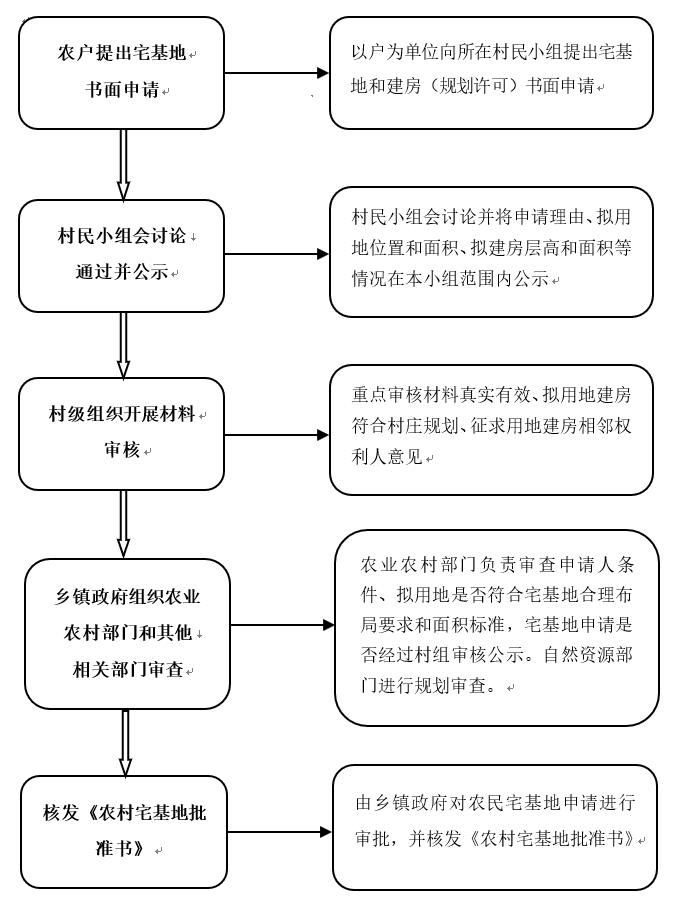
18. Can farmers use agricultural land for building houses?

Farmers can use agricultural land when building houses in line with the planning conditions, but they must go through the formalities of agricultural land conversion in advance according to law. Where agricultural land is converted into construction land, in accordance with the provisions of Article 44 of the Land Management Law, agricultural land other than permanent basic farmland is converted into construction land for the implementation of the plan within the scope of construction land for cities, villages and market towns determined in the overall land use plan, and it shall be approved by the organ that originally approved the overall land use plan or its authorized organ in batches according to the annual land use plan; Within the approved scope of agricultural land conversion, it can be specifically approved by the people’s government of the city or county. The conversion of agricultural land other than permanent basic farmland into construction land beyond the scope of construction land in cities, villages and market towns determined in the overall land use planning shall be approved by the people’s governments of provinces, autonomous regions and municipalities directly under the Central Government authorized by the State Council or the State Council. Permanent basic farmland to construction land, approved by the State Council.

On March 12, 2020, the State Council issued the Decision on the Authorization and Entrustment of Land Use Approval Authority (Guo Fa [2020] No.4), which on the one hand authorized the people’s governments of provinces, autonomous regions and municipalities directly under the Central Government to approve the conversion of agricultural land other than permanent basic farmland that the State Council can authorize into construction land. In accordance with the provisions of the third paragraph of Article 44 of the Land Administration Law of the People’s Republic of China, the State Council authorizes the people’s governments of all provinces, autonomous regions and municipalities directly under the Central Government to approve the conversion of agricultural land other than permanent basic farmland into construction land in batches within the scale of construction land in the State Council. According to the fourth paragraph of Article 44 of the Land Management Law of the People’s Republic of China, the State Council authorizes the people’s governments of all provinces, autonomous regions and municipalities directly under the Central Government to approve the conversion of agricultural land other than permanent basic farmland into construction land beyond the scope of construction land in cities, villages and market towns determined by the overall land use planning. On the other hand, the conversion of permanent basic farmland into construction land and the approval of land expropriation in the State Council are entrusted to the people’s governments of some provinces, autonomous regions and municipalities directly under the Central Government for approval. The first batch of pilot provinces are Beijing, Tianjin, Shanghai, Jiangsu, Zhejiang, Anhui, Guangdong and Chongqing, and the pilot period is one year. 19. After transferring the homestead, can farmers apply for the homestead again?

According to the provisions of Article 62 of the Land Management Law, rural villagers who sell, lease or donate their houses and then apply for homestead shall not be approved.

20. What is the nature of the right to use rural homestead?

The right to use the homestead is a usufructuary right. Chapter XIII of Part III of the Property Law "usufructuary right" is devoted to regulating the right to use homestead, among which Article 152 stipulates that "the owner of homestead right has the right to possess and use collectively owned land according to law, and has the right to use the land to build houses and ancillary facilities according to law".

21. Can farmers who settle in cities continue to retain the right to use their homesteads?

Farmers who settle in cities can retain their legally acquired right to use the homestead according to law.

According to the spirit of "Several Opinions of the Central Committee of the Communist Party of China and the State Council on Adhering to Priority Development of Agriculture and Rural Areas and Doing a Good Job in" Agriculture, Countryside and Farmers "(Zhongfa [2019] No.1)," Insist on safeguarding farmers’ land rights and interests, and do not take withdrawing contracted land and homestead as the condition for farmers to settle in cities ",farmers who settle in cities cannot be forced to give up their legally obtained right to use homestead. Prior to this, the Notice of the Ministry of Land and Resources on Further Accelerating the Registration and Certification of Homestead and Collective Construction Land (Guo Tu Zi Fa [2016] No.191) stipulated that "after farmers settle in the city, their legally acquired homestead use rights should be registered." 22. Can rural homesteads and farmhouses be inherited?

Rural homestead cannot be inherited, and rural houses can be inherited according to law.

Rural homestead ownership, homestead use right and house ownership are separated, homestead ownership belongs to farmers’ collective, and homestead use right and house ownership belong to farmers. The right to use the homestead takes the household as the unit and enjoys the right to occupy and use the homestead according to law. In the case of the death of a member in the house and the existence of farmers, the problem of homestead inheritance does not occur. When farmers die, the subject of rights no longer exists and the right to use the homestead is lost. At the same time, according to the relevant provisions of the inheritance law, the house of the decedent is inherited by the heir as his inheritance. Because the premises can’t be separated, the heirs can use the homestead according to law after inheriting the house and obtaining the ownership of the house, but they don’t obtain the usufructuary right to use the homestead.

23. What is the "integrated real estate" title deed?

The property right certificate of "integration of real estate and premises" is the proof of the ownership of real right. According to the Provisional Regulations on the Registration of Real Estate, the Detailed Rules for the Implementation of the Provisional Regulations on the Registration of Real Estate, and the Code of Practice for the Registration of Real Estate (for Trial Implementation), the rural homestead, collective construction land and the buildings and structures on it will be uniformly issued after unified ownership investigation and ownership registration.
Certificate of immovable property right of "integration of real estate and premises" 24. What materials do I need to submit for the "property-integrated" property right certificate?

To apply for the first registration of the right to use the homestead and the ownership of the house, the following materials shall be submitted according to different situations: (1) the applicant’s ID card and household registration book; (two) the ownership certificate of real estate or the document of the people’s government that has the right to approve the land use and other ownership source materials; (3) Relevant materials that the house conforms to the planning or construction; (four) the title questionnaire, land map, house plan and land boundary point coordinates and other materials related to the boundary and area of real estate; (5) Other necessary materials.

Where the right to use the homestead and the ownership of the house have been transferred due to inheritance according to law, division of property, exchange of houses within collective economic organizations, etc., the applicant shall submit the following materials according to different circumstances: (1) Certificate of ownership of real estate or other sources of ownership; (2) Materials inherited according to law; (3) agreements or materials on the division of property: (4) agreements on the exchange of houses within collective economic organizations; (5) Other necessary materials. 25. How to confirm the registration of the historical excessive occupation of homestead?

According to the former Ministry of Land and Resources, the Office of the Central Leading Group for Rural Work, the Ministry of Finance and the former Ministry of Agriculture, "Several Opinions on the Registration and Certification of Rural Collective Land Ownership" (No.178 [2011] of the Ministry of Land and Resources), according to different historical stages, the over-sized homestead was registered and certified.

Before the implementation of the Regulations on the Administration of Land for Building in Villages and Towns in 1982, if the homestead occupied by rural villagers for building has not expanded its land area since the implementation of the Regulations on the Administration of Land for Building in Villages and Towns, it can be registered for confirmation according to the existing actual use area;

From the implementation of the Regulations on the Management of Land for Building in Villages and Towns in 1982 to the implementation of the Land Management Law in 1987, if the homestead occupied by rural villagers for building houses exceeds the local area standard, after the excess part is handled according to the relevant national and local regulations at that time, it can be registered according to the actual use area;

After the implementation of the Land Management Law in 1987, if the homestead occupied by rural villagers exceeds the local area standard, the ownership registration shall be carried out according to the actual approved area. If the area exceeds the local standard, the area exceeding the standard can be indicated in the land register and the note column of the land title certificate. When the household building or the existing house is demolished, rebuilt, renovated or rebuilt, and the government implements the planning and reconstruction according to law, it will be dealt with according to the relevant regulations, and the ownership registration will be re-registered according to the local standard. Part III Utilization of Homestead 26. What are the main ways to make use of idle homesteads and idle houses?

The factors such as location conditions, resource endowment, environmental capacity, industrial base and historical and cultural heritage should be considered as a whole, and the rural idle homesteads and idle houses should be selected for active utilization. According to the Notice of the Ministry of Agriculture and Rural Affairs on Actively and Steadily Carrying out the Revitalization and Utilization of Rural Idle Homestead and Idle Houses (No.4 [2019]), there are mainly the following ways to revitalize the utilization:

First, use idle houses to develop new industries and new formats such as leisure agriculture, rural tourism, catering and lodging, cultural experience, creative office, e-commerce and so on.

The second is to use idle houses to develop agricultural products cold chain, primary processing, warehousing and other first, second and third industries integration development projects.

Third, by means of consolidation, reclamation and greening, we will carry out the renovation of rural idle homesteads, make use of policies such as linking the increase and decrease of urban and rural construction land according to laws and regulations, and entering the market with collective construction land, so as to provide land and other factors for farmers to build houses, rural construction and industrial development. 27. What are the main bodies of idle homesteads and idle houses?

The Notice of the Ministry of Agriculture and Rural Affairs on Actively and Steadily Carrying out the Revitalization and Utilization of Rural Idle Homestead and Idle Houses (No.4 [2019] of the Ministry of Agriculture and Rural Affairs) proposes to protect the legitimate rights and interests of various subjects in accordance with the law and promote the formation of a good situation of multi-participation and win-win cooperation. The main body of active utilization mainly includes the following three categories:

First, rural collective economic organizations and their members. On the premise of fully protecting the legitimate rights and interests of farmers’ homesteads, support rural collective economic organizations and their members to revitalize and utilize rural idle homesteads and idle houses in various ways such as self-employment, leasing, shareholding and cooperation. Encourage rural collective economic organizations with certain economic strength to make unified use of idle homesteads and idle houses.

The second is returnees. Support returnees to rely on their own and idle houses to develop suitable rural industrial projects. "Opinions of General Office of the State Council on Supporting Entrepreneurial Innovation of Returned Rural Workers to Promote the Integrated Development of Rural Primary, Secondary and Tertiary Industries" (Guo Ban Fa [2016] No.84) puts forward that "supporting returned rural workers to develop farmhouse music by relying on their own and idle farmhouses. Under the premise of complying with the rural homestead management regulations and related plans, people returning to the countryside and farmers are allowed to cooperate to rebuild their own houses. "

The third is social enterprises. Guide enterprises with strength, willingness and responsibility to participate in the revitalization and utilization of idle homesteads and idle houses in an orderly manner. 28. What are the support policies to encourage the active use of idle homesteads?

First, financial rewards and subsidies. Co-ordinate arrangements for relevant funds, for rural idle homestead and idle residential use incentives, subsidies, etc.

Second, financial innovation supports the revitalization and utilization of projects. When conditions are ripe, local government special bonds will be issued to support rural idle homesteads and idle residential projects. Promote the innovation of financial credit products and services, and provide support for the revitalization and utilization of rural idle homesteads and idle houses.

The third is the social promotion of resource projects. Combined with rural tourism conference, agricultural carnival, agricultural fair and other activities, to promote rural idle homestead and idle residential resources to the society.

29. How to steadily promote the pilot demonstration of the revitalization and utilization of idle homesteads?

All localities, in light of the actual situation, selected a number of areas that local party committees and governments attach importance to, rural collective economic organizations are sound, rural residential land management is standardized, rural industries have a foundation, and farmers have high enthusiasm, and orderly carried out pilot demonstrations on the revitalization and utilization of rural idle residential land and idle houses. Highlight the characteristics of rural industries, integrate resources, and create a number of models for the revitalization and utilization of homestay (farmhouse) concentrated villages, rural tourism destinations, family workshops, and handicraft workshops. Summarize a batch of replicable and popularized experience models, explore a set of standardized and efficient operation mechanism and management system, and gradually push them away.

30. How to regulate the active use of idle homesteads according to law?

Further strengthen the management of homestead, standardize the utilization mode, business industry, lease term, transfer object, etc., to prevent encroachment on cultivated land, large-scale demolition and construction, and illegal development, and ensure that idle rural homestead and idle houses that are revitalized are obtained according to law and have clear ownership.

We must resolutely stick to the bottom line of laws and policies, and must not illegally recover the homestead legally obtained by farmers, and must not illegally buy or sell homesteads in disguise. It is strictly forbidden to use rural homesteads to build villa courtyards and private clubs in the countryside.

For the use of idle houses to develop homestays and other projects, in accordance with the requirements of Document No.1 of the Central Committee in 2018, measures such as facilitating market access and strengthening post-event supervision in areas such as fire protection and special industry operations should be studied and promoted as soon as possible.

31. What are the rules for developing homestays and using farmers’ farmhouses?

According to the Basic Requirements and Evaluation of Tourist Homes issued by the Ministry of Culture and Tourism in 2019 (LB/T
065—2019), tourist B&B refers to small accommodation facilities that use local residential and other related idle resources, with no more than 4 floors of business rooms and no more than 800 square meters of construction area, and the host participates in the reception, providing tourists with experience of local nature, culture and production and lifestyle, and can be divided into urban B&B and rural B&B.. The business site of tourist homestays shall conform to the overall land and space planning of this city and county (including the current overall urban planning and land use planning) and the relevant planning for the development of local homestays. Operating a homestay should comply with the relevant regulations and requirements of public security, fire protection, sanitation, environmental protection and safety, and obtain the relevant licenses required by the local government. Some places, such as Beijing, Shanghai, Hainan, etc., have issued policy documents according to local conditions, and made specific provisions on the development of homestays by using rural houses to promote the sustainable and healthy development of rural homestays.

The Notice of the Ministry of Agriculture and Rural Affairs of the Central Rural Work Leading Group Office on Further Strengthening the Management of Rural Homestead (Zhong Nong Fa [2019] No.11) stipulates that village collectives and farmers are encouraged to make full use of idle homesteads and idle houses, and develop farmhouse music, homestays and rural tourism according to laws and regulations through independent operation, cooperative operation and entrusted operation. Urban residents, industrial and commercial capital, etc. who rent farmhouses to live or operate shall strictly abide by the provisions of the contract law, and the term of the lease contract shall not exceed 20 years. After the expiration of the contract, both parties may make another agreement. 32. How to promote the economical and intensive use of homestead?

According to the provisions of the Land Management Law, rural villagers should build houses in accordance with the overall land use planning and village planning of townships (towns), and should not occupy permanent basic farmland, and try to use the original homestead and village Uchikoga.

The Notice of the Ministry of Agriculture and Rural Affairs of the Office of the Central Rural Work Leading Group on Further Strengthening the Management of Rural Homestead (Zhong Nong Fa [2019] No.11) further requires that the land used for homesteads should be rationally arranged, and the occupation of agricultural land by new homesteads should be strictly controlled, and permanent basic farmland should not be occupied; Involving the occupation of agricultural land, it shall go through the formalities for the conversion of agricultural land in advance according to law. Villages outside the scale of urban construction land should increase the homestead space by giving priority to new construction land planning indicators, village renovation, and vacating abandoned homesteads to meet the housing needs of farmers who meet the conditions of homestead allocation. Within the scale of urban construction land, farmers’ housing needs can be met by building farmers’ apartments and farmers’ residential quarters. 33. Can rural homesteads and farmers’ houses be mortgaged?

In addition to the pilot areas authorized by the National People’s Congress Standing Committee (NPCSC) to carry out mortgage loans for farmers’ housing property rights, rural homesteads and rural houses in other places cannot be mortgaged.

Article 184 of the Property Law stipulates that the right to use collectively-owned land, such as cultivated land, homestead, private plot and private plot, shall not be mortgaged, except as stipulated by law. Article 37 of the Guarantee Law stipulates that collectively owned land use rights such as cultivated land, homestead, private plots and private plots cannot be mortgaged.

At the same time, Article 182 of the Property Law stipulates that if a building is mortgaged, the right to use the construction land occupied by the building shall be mortgaged together. Where the right to use construction land is mortgaged, the buildings on the land shall be mortgaged together. That is to say, China implements the principle of "integration of real estate and premises", because the right to use the homestead cannot be mortgaged, resulting in the fact that the rural houses on it cannot be mortgaged.

The fourth part of the homestead circulation

34. What are the ways to transfer the right to use the homestead?

The transfer mode of homestead use right includes transfer and lease. 35. What conditions must be met for the transfer of the right to use rural residential land?

The transfer of the right to use the homestead must be carried out within the village collective economic organization with the consent of the owner of the homestead, and the transferee must be a rural villager who meets the application conditions of the homestead. All provinces (autonomous regions and municipalities directly under the Central Government) shall meet other requirements for the transfer of homestead at the same time. 36. Can urban residents buy homesteads in rural areas?

I can’t.

The State Council’s Decision on Deepening Reform and Strict Land Management (Guo Fa [2004] No.28) clearly stipulates that urban residents are prohibited from purchasing homestead in rural areas. The Notice of the Ministry of Agriculture and Rural Affairs of the Central Rural Work Leading Group Office on Further Strengthening the Management of Rural Homestead (Zhong Nong Fa [2019] No.11) requires that "Homestead is the basic living guarantee for rural villagers, and it is strictly forbidden for urban residents to buy homesteads in rural areas, and it is strictly forbidden to use rural homesteads to build villa compounds and private clubs in rural areas. It is strictly forbidden to occupy or buy or sell homesteads in violation of laws and regulations in the name of circulation. "

37. What is the longest period for renting a farm house?

Article 214th of the Contract Law stipulates that the lease term shall not exceed 20 years. More than twenty years, the excess part is invalid. Upon the expiration of the lease term, the parties may renew the lease contract, but the agreed lease term shall not exceed 20 years from the date of renewal.

The Notice of the Ministry of Agriculture and Rural Affairs of the Central Rural Work Leading Group Office on Further Strengthening the Management of Rural Homestead (Zhong Nong Fa [2019] No.11) stipulates that urban residents, industrial and commercial capital and other rented farmhouses must strictly abide by the provisions of the contract law, and the term of the lease contract shall not exceed 20 years. After the expiration of the contract, both parties may make another agreement. The fifth part of the homestead withdrawal 38. Under what circumstances can the village collective recover the farmer’s homestead?

Under any of the following circumstances, the village collective may recover the right to use the homestead with the approval of the people’s government that originally approved the land use:

(1) If the township (town) village needs to use land for the construction of public facilities and public welfare undertakings, it shall collectively recover the right to use the homestead and give appropriate compensation to the right holder of the homestead;

(2) not using the homestead in accordance with the approved purposes;

(3) Stop using the homestead due to cancellation, relocation and other reasons;

(4) Idle or houses collapse, and the homestead that has not been restored for more than two years is demolished, and the land use right is no longer determined. If the right to use has been determined, it shall be reported by the collective to the people’s government at the county level for approval, and its land registration shall be cancelled and the right to use the homestead shall be collectively recovered;

(5) Non-agricultural registered permanent residence residents (including overseas Chinese) whose original homestead in rural areas has no change in housing property rights can determine their collective construction land use rights according to law. If the reconstruction is not approved after the house is demolished, the right to use the homestead shall be collectively recovered;

(6) When determining the right to use rural residents’ homestead, if the area exceeds the standard set by the local government, the number exceeding the standard area can be indicated in the land registration card and the warrant. In the future, when building houses by households or existing houses are demolished, rebuilt or rebuilt, or the government implements planning and reconstruction according to law, the right to use shall be re-determined according to the area standard stipulated by the local government, and the right to use shall be recovered by the collective;

(7) Other circumstances stipulated by the local government. 39. What are the provisions for voluntary and paid withdrawal of rural homestead?

Article 62 of the Land Management Law stipulates that the state allows rural villagers who have settled in cities to voluntarily withdraw from their homesteads with compensation according to law, and encourages rural collective economic organizations and their members to make active use of idle homesteads and idle houses.

The Notice of the Ministry of Agriculture and Rural Affairs of the Central Rural Work Leading Group Office on Further Strengthening the Management of Rural Homestead (Zhong Nong Fa [2019] No.11) stipulates that rural villagers who have settled in cities can raise funds through various channels and explore ways to encourage them to voluntarily withdraw from their homesteads. 40. What is the procedure for farmers to withdraw from the homestead?

In the pilot exploration of homestead system reform, farmers’ withdrawal from homestead mainly includes the following steps: farmers submit a written application, village audit, professional institutions evaluate the value, farmers sign an agreement with village collectives, farmers get compensation, and county-level authorities change registration.

41. Can farmers apply again after voluntarily withdrawing from the homestead?

Judging from the pilot exploration of homestead system reform, some pilot areas distinguish the withdrawal of homestead and determine whether to continue to apply, mainly including the following situations:

One is to quit completely. Voluntary paid withdrawal from the legal occupation of homestead, and no longer retain the eligibility for the right to use homestead, can not apply again. In this case, farmers can generally get complete compensation.

The second is partial withdrawal. If you withdraw from the legally occupied homestead but continue to retain the eligibility for the right to use the homestead, you can apply again if necessary within the agreed time limit. In this case, farmers can get less exit compensation.

The third is to illegally occupy the homestead and withdraw. For the homestead occupied by farmers in violation of laws and regulations, all localities generally adopt the method of free withdrawal, and can not apply again after withdrawal. 42. How to use the homestead that farmers quit?

The Notice of the Ministry of Agriculture and Rural Affairs of the Office of the Central Rural Work Leading Group on Further Strengthening the Management of Rural Homestead (Zhong Nong Fa [2019] No.11) proposes that under the premise of respecting farmers’ wishes and conforming to the plan, village collectives should be encouraged to comprehensively rectify the abandoned homestead, and the rectified land should be given priority to meet farmers’ demand for new homesteads, village construction and rural industrial development. The land value-added income generated by the active use of idle homesteads should all be used for agriculture and rural areas. 43. How to compensate for the expropriation of rural homestead?

The expropriation of homestead, property law and land management law have all been clearly stipulated.

Article 42 of the Property Law stipulates that in order to meet the needs of public interests, the expropriation of collectively owned land shall pay the land compensation fee, resettlement subsidy, compensation fee for ground attachments and young crops in full according to law, arrange social security fees for landless farmers, safeguard their lives and safeguard their legitimate rights and interests. The expropriation of houses and other immovable property of units and individuals shall be compensated for demolition according to law, and the legitimate rights and interests of the expropriated person shall be safeguarded; Where individual houses are expropriated, the living conditions of the expropriated person shall also be guaranteed.

Paragraph 4 of Article 48 of the Land Management Law stipulates that the compensation standards for expropriation of land other than agricultural land, ground attachments and young crops shall be formulated by provinces, autonomous regions and municipalities directly under the Central Government. The rural villagers’ houses should be compensated fairly and reasonably in accordance with the principle of compensation before relocation and improvement of living conditions, and the wishes of rural villagers should be respected, and fair and reasonable compensation should be given by rearranging the homestead for building, providing resettlement houses or monetary compensation, and compensation should be paid for the relocation and temporary resettlement expenses caused by expropriation, so as to protect the rural villagers’ living rights and legitimate housing property rights and interests. 44. How to protect the legitimate rights and interests of farmers’ homestead?

Homestead is the basic residential security land for rural villagers. The Notice of the Ministry of Agriculture and Rural Affairs of the Office of the Central Rural Work Leading Group on Further Strengthening the Management of Rural Homestead (Zhong Nong Fa [2019] No.11) requires: the qualification right of homestead farmers and the property right of farmers should be fully guaranteed. It is not allowed to forcibly transfer the homestead against the wishes of farmers and force farmers to "go upstairs" in various names, and it is not allowed to illegally recover the homestead legally obtained by farmers, and it is not allowed to withdraw from the homestead as a condition for farmers to settle in cities. Strictly control the merger of the whole village, standardize the implementation procedures, and strengthen supervision and management. It is strictly forbidden to occupy or buy or sell homestead illegally in the name of circulation. Part VI Supervision and Management of Homestead 45. What are the functions of the Ministry of Agriculture and Rural Affairs on Homestead?

According to the Land Management Law and the "Three Decisions" plan of the Ministry of Agriculture and Rural Affairs, the Ministry of Agriculture and Rural Affairs is responsible for the reform and management of rural housing sites. To undertake the reform of rural homestead system, be responsible for drafting the draft laws, regulations and policies related to the management and use of rural homestead, guide the distribution, use and circulation of rural homestead, dispute arbitration management, rational layout of rural homestead, land use standards, and investigation and punishment of illegal land use, and guide the utilization of idle homesteads and idle farmhouses. 46. What is the division of responsibilities between the agricultural and rural departments and the natural resources departments about rural residential sites?

According to the department’s "three decisions" plan, the agricultural and rural departments are responsible for the reform and management of rural housing sites; The natural resources department is responsible for the conversion of land and other land space uses, land consolidation and reclamation, unified registration of real estate rights, formulation of land space planning and supervision of its implementation. In the specific work, the natural resources department is responsible for village planning, annual land use plan, rural construction planning permission, registration and certification of the right to use the homestead integrated with real estate, and the agricultural and rural departments are responsible for the management, reform, utilization, investigation and supervision of the homestead.

47. What is the working mechanism of rural homestead management?

The management mechanism of rural homestead is guided by the Ministry and the province, led by cities and counties, with the township as the main responsibility and the village as the main body. The focus of homestead management is at the grass-roots level, county and township governments assume territorial responsibility, agricultural and rural departments are responsible for industry management, and the specific work is undertaken by rural management departments. County and township governments should strengthen organizational leadership, earnestly strengthen the construction of grass-roots rural management system, increase support, enrich their strength, implement funds, improve conditions, and ensure that people are responsible for the work. 48. What does the "three presence" of rural homestead approval supervision mean?

The "Three Arrivals" of rural homestead approval and supervision refers to the arrival of homestead application review, measurement and approval before construction and verification and acceptance after completion.

Homestead application review: After receiving the application for homestead and building (planning permission), the township government should promptly organize the agricultural, rural and natural resources departments to review whether the applicant meets the conditions and whether the proposed land meets the planning and land type.

Before the start of construction, the farmers who have been approved to build houses with land shall apply to the township government or the authorized lead department to demarcate the land scope of the homestead before the start of construction, and the township government shall promptly organize the departments of agriculture, rural areas and natural resources to conduct on-site inspection, measure and approve the homestead on the spot, and determine the location of building.

Upon completion, check and acceptance will be present: after the completion of farmers’ housing construction, the township government will organize relevant departments to carry out acceptance inspection, on-the-spot check whether farmers use the homestead in accordance with the requirements of the approved area and four areas, and whether they build houses in accordance with the approved area and planning requirements, and issue the Acceptance Opinion Form for Rural Homestead and Building (Planning Permission).

49. What role should village-level organizations play in the daily management of homestead?

Rural homestead is owned by farmers collectively, and collective economic organizations or village committees exercise the ownership of rural homestead. Village-level organizations, under the guidance of township governments, should improve the democratic management methods of village homesteads, explore the establishment of village-level homestead coordinators, and manage and make good use of homesteads according to law. In the process of applying for examination and approval, be responsible for the preliminary examination and participate in the implementation of the requirements of "Three Arrivals" in the whole process, and mainly participate in the on-site inspection organized by the township government, measure and release the homestead on the spot, and determine the building location; After the completion of housing construction, farmers participate in the acceptance link organized by the township government, and on-the-spot check whether farmers use the homestead in accordance with the approved area and four requirements, and whether they build housing in accordance with the approved area and planning requirements. Strengthen the daily inspection of rural residential sites, discover and stop all kinds of illegal acts involving residential sites in time, and report to superiors in time if they refuse to dissuade or correct. 50. How to solve the problems left over from the history of rural homestead?

The problems left over from the history of rural homestead, such as "one household with more houses" and over-standard area, have complex causes and involve the vital interests of farmers. They should be classified and identified according to local conditions and laws and policies, and properly disposed of.

First, combined with the third national land survey and other work, carry out statistical surveys on rural residential sites to grasp the basic situation.

Second, the registration and certification of the right to use the homestead, which is integrated with the real estate, is classified according to the laws and policies of different periods.

Third, combined with the implementation of village planning, new rural construction, rural human settlements improvement, etc., the over-occupation, over-occupation, and indiscriminate occupation of homesteads will be gradually adjusted according to the plan.

The fourth is to guide the village level to resolve some remaining problems through democratic consultation and villagers’ autonomy.

Fifth, strengthen the management of rural residential sites to prevent new illegal acts. 51. What legal responsibilities should farmers bear for illegally occupying land to build houses?

China implements the strictest farmland protection system and land saving system, and insists on land use control, and it is strictly forbidden to occupy homestead beyond the standard. The land management law and the urban and rural planning law clearly define the corresponding legal responsibilities for illegal land occupation and building.

Article 75 of the Land Management Law stipulates that, in violation of the provisions of this Law, those who occupy cultivated land to build kilns and graves, or build houses, dig sand, quarry, mine and borrow soil on cultivated land without authorization, which damages the planting conditions, or cause desertification and salinization of land due to land development, shall be ordered by the competent departments of natural resources of the people’s governments at or above the county level and the competent departments of agriculture and rural areas to make corrections within a time limit and may also be fined; If a crime is constituted, criminal responsibility shall be investigated according to law.

Article 77 of the Land Management Law stipulates that: those who illegally occupy land without approval or by deception shall be ordered by the competent department of natural resources of the people’s government at or above the county level to return the illegally occupied land; those who change agricultural land into construction land without authorization in violation of the overall land use plan shall dismantle the newly built buildings and other facilities on the illegally occupied land within a time limit and restore the land to its original state; those who meet the overall land use plan shall be confiscated and may be fined; The directly responsible person in charge and other directly responsible personnel of illegal land occupation units shall be punished according to law; If a crime is constituted, criminal responsibility shall be investigated according to law. Occupation of land in excess of the approved amount shall be punished as illegal occupation of land.

Article 78 of the Land Management Law stipulates that if rural villagers illegally occupy land to build houses without approval or by deception, the competent agricultural and rural departments of the people’s governments at or above the county level shall order them to return the illegally occupied land and dismantle the newly built houses on the illegally occupied land within a time limit. If the land exceeds the standards set by provinces, autonomous regions and municipalities directly under the Central Government, it will be punished as illegal occupation of land.

Article 65 of the Urban and Rural Planning Law stipulates that if a rural construction planning permit is not obtained in accordance with the law or construction is not carried out in accordance with the provisions of the rural construction planning permit, the township and town people’s governments shall order it to stop construction and make corrections within a time limit; If it is not corrected within the time limit, it can be removed. 52. What are the law enforcement procedures for investigating and dealing with illegal acts of rural residential land?

In the administrative law enforcement of illegal land use of homestead, the competent agricultural and rural departments at or above the county level shall, according to Articles 67 and 68 of the Land Administration Law, first order them to stop the illegal acts and perform the right of supervision and inspection; The second is to order the demolition within a time limit and make an administrative penalty decision to order the demolition within a time limit. If the illegal act continues, it shall be dealt with according to article 83.

Article 83 of the Land Management Law: "If, in accordance with the provisions of this Law, the newly-built buildings and other facilities on illegally occupied land are ordered to be demolished within a time limit, the construction unit or individual must immediately stop the construction and dismantle them by itself; To continue the construction, the organ that made the decision on punishment has the right to stop it. If the construction unit or individual refuses to accept the decision on administrative punishment of ordering demolition within a time limit, it may bring a suit in a people’s court within fifteen days from the date of receiving the decision on ordering demolition within a time limit; If it fails to prosecute and dismantle itself at the expiration of the time limit, the organ that made the punishment decision shall apply to the people’s court for compulsory execution according to law, and the expenses shall be borne by the offender. "

In accordance with the spirit of deepening the constitutional reform of administrative law enforcement by the central authorities and the General Office of the General Office of the Central Committee of the CPC and the State Council’s "Implementation Opinions on Promoting the Law Enforcement Force of Grassroots Integration of Examination and Approval Services" (No.5 [2019] of the Office of the Central Committee), all localities can explore gradually giving the rural homestead law enforcement power to the township people’s government for implementation in accordance with legal procedures and requirements.

53. What are the ways to resolve disputes over rural residential sites?

Article 14 of the Land Administration Law stipulates that disputes over land ownership and use rights shall be settled by the parties through consultation; If negotiation fails, it shall be handled by the people’s government.

Disputes between units shall be handled by the people’s governments at or above the county level; Disputes between individuals or between individuals and units shall be handled by people’s governments at the township level or above the county level.

If a party refuses to accept the decision of the relevant people’s government, he may bring a suit in a people’s court within 30 days from the date of receiving the notice of the decision.

Before the dispute over land ownership and use right is settled, neither party may change the status quo of land use.

Homestead disputes can also be resolved through people’s mediation. People’s mediation refers to a kind of mass autonomy activity under the auspices of mediation committees (including urban residents’ committees and rural villagers’ committees), based on national laws, regulations, policies and social ethics, to persuade and educate the parties to civil disputes, to promote mutual understanding and equal consultation between the parties to disputes, so as to reach an agreement voluntarily and eliminate disputes. People’s mediation is an important part of the current mediation system and a unique system in China’s legal system construction. 54. What basic work should be done in rural homestead management?

Combined with the land survey, registration and certification of the right to use the homestead, we will promote the establishment of a statistical survey system for rural homesteads, organize surveys on the utilization of homesteads and rural houses, and comprehensively understand the scale, layout and utilization of homesteads. Gradually establish the basic information database and management information system of homestead, and promote the information management of homestead application, approval, circulation, withdrawal and illegal land use investigation.

Strengthen investigation and study, timely study and solve new situations and new problems in the process of homestead management and reform, pay attention to summing up the good experiences and practices created by grassroots and farmers, implement the newly revised land management law, and timely revise and improve the local homestead management measures.

Strengthen organization and leadership, strengthen self-construction, increase the training of laws and policies, promote team building through work, and do a good job in homestead management.
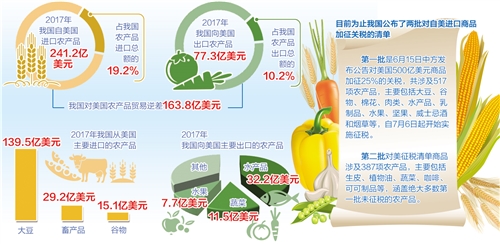
Imposing tariffs on agricultural products imported from the United States has little impact on China.

Imposing tariffs on agricultural products imported from the United States has little impact on China.
-Interview with Han Jun, Deputy Director of the Central Agricultural Office and Vice Minister of Agriculture and Rural Affairs.

In view of the hot issues related to agricultural products in Sino-US economic and trade frictions, the reporter recently interviewed Han Jun, deputy director of the Central Agricultural Office and vice minister of agriculture and rural affairs.

China’s agricultural trade has a huge volume and a broad market.

Reporter: Please tell us about the overall situation of Sino-US agricultural trade in recent years. How do you evaluate the development of Sino-US agricultural trade?

Han Jun: Agricultural products trade plays an important role in Sino-US economic and trade relations. China is the world’s largest importer of agricultural products, and the United States is the world’s largest exporter of agricultural products. Strengthening agricultural trade cooperation between China and the United States is conducive to promoting the agricultural development of the two countries.

American agriculture has a high level of modernization and strong competitiveness. Expanding the export of agricultural products to China has always been the focus of the United States to expand overseas markets. Agriculture has always been a core issue in Sino-US economic and trade consultations. In 2017, China imported 24.12 billion US dollars of agricultural products from the United States, accounting for 19.2% of China’s total agricultural products imports; Exports of agricultural products to the United States amounted to $7.73 billion, accounting for 10.2% of China’s total agricultural exports; China’s agricultural trade deficit with the United States reached $16.38 billion.

China and the United States have different endowments of agricultural resources, and the trade of agricultural products is highly complementary. The advantages of land-intensive agricultural products in the United States are outstanding, while the advantages of labor-intensive agricultural products in China are obvious. In 2017, China mainly imported soybeans (US$ 13.95 billion), livestock products (US$ 2.92 billion) and cereals (US$ 1.51 billion) from the United States; China’s agricultural products exported to the United States are mainly aquatic products ($3.22 billion), vegetables ($1.15 billion) and fruits ($770 million).

China will have a huge demand for agricultural products imports in the future. It is China’s established policy to actively expand agricultural products imports, which is a big cake for global agricultural products exporting countries. We hope that Sino-US agricultural trade can develop healthily, and American farmers can share the cake of China’s expansion of agricultural products imports. The United States ignores the consensus reached by both sides and constantly escalates trade frictions. We firmly oppose it. China is unwilling to engage in a trade war with the United States, but in the face of what the United States has done, China has to introduce necessary countermeasures. If a trade war breaks out between China and the United States, many countries are willing and fully capable of replacing the market share of American agricultural products in China. I have noticed that the American agricultural community is deeply worried about this and hopes to resolve the trade differences between the two countries through negotiations.

China is fully capable of coping with the gap in the reduction of soybean imports in the United States.

Reporter: In response to the economic and trade frictions provoked by the United States, China has taken different measures against some agricultural products imported from the United States. What is the specific situation? Why do you take these measures?

Han Jun: Under the strong leadership of the CPC Central Committee, we resolutely safeguard the core interests of the country, rationally handle Sino-US economic and trade issues, and have to take necessary countermeasures in the agricultural field. So far, China has published two lists of tariffs on goods imported from the United States. Regarding the first batch, China issued an announcement to impose a 25% tariff on US$ 50 billion goods, including US$ 34 billion goods including agricultural products, which will be taxed from July 6, 2018, and the remaining US$ 16 billion goods will be taxed simultaneously with the US. The tax involved 517 agricultural products. In 2017, the total import from the United States was about 21 billion US dollars, mainly including soybeans, grains, cotton, meat, aquatic products, dairy products, fruits, nuts, whisky and tobacco. Regarding the second batch, China has decided to impose tariffs on about $60 billion of products imported from the United States at four different tax rates: 25%, 20%, 10% and 5%. The second batch of goods on the US tax list involves 387 agricultural products. In 2017, the total import from the US was about US$ 2.9 billion, mainly including hides, vegetable oils, vegetables, coffee and cocoa products, which have covered the vast majority of the first batch of untaxed agricultural products.

At present, the first batch of tax products that China has implemented covers nearly 90% of agricultural products imported from the United States, and agricultural products that the United States exports to China are among them, such as soybeans, grains, cotton, pork and other products. China’s countermeasures were put forward after listening to opinions extensively and carefully evaluating the impact, and they were rational and restrained. As far as China is concerned, the impact of increasing tariffs on agricultural products imported from the United States is very limited because of the diverse import sources and wide import market. In the future, relevant departments will evaluate the effect of countermeasures and strive to minimize the impact of countermeasures on domestic production and life.

Reporter: Among these measures, soybeans are undoubtedly the most concerned. Why has China been importing a large number of American soybeans? Will the soybean import gap caused by countermeasures have a greater impact on China’s edible oil and livestock and poultry breeding industry? What are the countermeasures?

Han Jun: Imported soybeans meet the demand for edible vegetable oil and protein feed. With the improvement of people’s living standards and the development of modern animal husbandry, the demand for edible oil and protein feed in China continues to grow. However, China’s land resources are limited, so it is difficult for us to ensure the basic self-sufficiency of staple foods such as wheat and rice, and at the same time ensure the effective supply of other land-intensive products such as soybeans. At present, the gap between domestic soybean production and demand is more than 90 million tons, which needs to be supplemented by the international market. The United States is the largest soybean producer in the world, with an annual output of more than 100 million tons, but its domestic consumption is limited, and about half of it depends on exporting to the international market.

At present, China’s soybean demand is still increasing, and the trend of large gap between domestic supply and demand will still exist. In 2017, soybean meal accounted for 72.3 million tons of 105 million tons of protein raw materials consumed by feed in China. China takes countermeasures against the United States, and soybean imports from the United States will drop significantly. Some people worry that it may have a certain impact on the supply of edible oil and livestock feed in China in the short term. In order to prevent the linkage effect and increase the pressure of rising domestic food prices, we have made thorough and sufficient preparations. It can be said that China is fully capable of coping with the gap of decreasing soybean imports in the United States. First, actively expand the source of soybean imports; Second, reduce the consumption of soybean meal by adjusting feed formula, reduce the demand for protein raw materials by applying new technology, and increase the import of other oilseeds and meal to make up for the gap of soybean meal; The third is to increase the supply of other edible vegetable oils; The fourth is to improve the soybean support policy and improve the comprehensive production capacity of domestic soybeans.

The impact on American agriculture is predictable.

Reporter: The United States is escalating trade disputes. If the United States insists on imposing tariffs on US$ 200 billion worth of China goods, what does it mean for American agriculture if China strongly opposes it?

Han Jun: My imports from the United States are mainly bulk agricultural products such as soybeans, cotton and pork. On July 6, 2018, the United States announced the implementation of the first round of tariff-added products (US$ 34 billion). As a countermeasure, China imposed a 25% tariff on US$ 34 billion goods, including agricultural products. Affected by the escalation of Sino-US economic and trade frictions, it is foreseeable that American agriculture will be damaged. Although the White House and the Ministry of Agriculture announced that they will implement the agricultural subsidy plan of up to $12 billion, American farmers will still face the risk of losing the China market that they have worked hard for decades.

Soybean is the most important product in Sino-US agricultural trade. In July, the Organization for Economic Cooperation and Development (OECD) predicted that the global soybean supply and demand would be basically balanced in 2018, and the soybean output in the United States would be 117.79 million tons, a decrease of 1.5% over the previous year. From 2015 to 2017, the United States exported 59% of its total soybean exports. Based on this, it is estimated that if there is no trade friction, the US soybean exports to China will be more than 30 million tons in 2018. Since I imposed a 25% tariff on American soybeans on July 6, my company has basically stopped purchasing American soybeans. Beginning in October 2018, American soybeans will be listed one after another, and the impact of China’s tariff increase on imported soybeans from the United States will gradually emerge. The United States will face problems such as falling soybean prices, increasing export pressure, and lengthening export cycle, which will bring losses to American soybean farmers and adversely affect the international trade and industrial development of American soybeans. According to monitoring, since I announced in early April that I intend to impose a 25% tariff on US soybeans, the US soybean futures price has fallen by nearly 20%.

On July 25, 2018, President Trump met with European Commission President Juncker, and a joint statement issued after the meeting stated that the EU agreed to import more American soybeans. In 2017, the EU-28 countries estimated that soybean imports were 13.65 million tons. From 2012 to 2016, the EU imported only 5.5 million tons of soybeans from the United States. According to the forecast of the Organization for Economic Cooperation and Development, the European Union’s soybean imports will be between 13 million tons and 14 million tons in the next 10 years. It is impossible for EU soybeans to be all imported from the United States, even if they are all imported from the United States, it will not solve the problem of tens of millions of tons of American soybeans that should have entered the China market.

The hearing held by the U.S. House of Representatives on July 19 also reflected the concern of people from all walks of life in American agriculture about losing market share. American soybean, grain, dairy products, meat, aquatic products, fruits and nuts have been operating in China for many years before gaining market share in China. The competition in China’s agricultural products market is fierce. If Sino-US economic and trade frictions escalate, American agricultural products will face higher costs in the China market, and their market share will be greatly weakened. Other competitors will not miss the opportunity and will occupy all the market share lost by the United States. If other countries become reliable suppliers to China, it will be difficult for the United States to regain the market. This is exactly what the American agricultural community is most worried about. They don’t want the long-term income to be affected by tariffs.

Actively, steadily and orderly expand agricultural opening to the outside world

Reporter: What is the impact of tariffs imposed by the United States and Canada on China’s agricultural products exported to the United States? How to deal with it?

Han Jun: The catalogue of the first round of products subject to tariff increase (US$ 34 billion) announced by the US on July 6th does not include the agricultural products exported by China. The catalogue of the products subject to the second round of tariff increase (US$ 200 billion) announced by the US on July 10th includes most of our aquatic products and fruit and vegetable products exported to the US.

In terms of aquatic products, the United States is my second largest aquatic product export market. In 2017, my aquatic products exported to the United States accounted for 12.8% and 15.2% of my total aquatic products exports respectively. Aquatic products are the main agricultural products exported to the United States, accounting for 42% of the total agricultural products exported to the United States. The US$ 200 billion commodity list covers all my aquatic products exported to the US. These products are exported to the United States with a high degree of dependence, especially tilapia, shrimp, crab, shellfish and other products. It is difficult to find other alternative markets in the short term and may be affected to some extent. In the next step, the Ministry of Agriculture and Rural Affairs, together with relevant departments, will guide relevant producers to actively explore international alternative markets, strengthen efforts to crack down on smuggling, guide and adjust the structure of breeding varieties, facilitate domestic circulation and sales, expand domestic consumption, and minimize the impact.

In terms of fruit and vegetable products, the United States is the fifth largest vegetable export market and the third largest fruit export market. There are more than 200 kinds of fruit and vegetable products in the list of tariff increase announced by the United States, covering 93% of vegetable products and 99% of fruit products exported to the United States. It is expected that taxation will have a certain impact on the income and employment of relevant fruit farmers and vegetable farmers. However, considering the strong absorption capacity of domestic consumption and the generally lower prices of domestic fruit and vegetable products this year, the actual impact of the US-Canada tariff on the export of our fruit and vegetable products remains to be seen. Next, we will improve the quality of fruit and vegetable products from the production side, enhance market competitiveness and expand the domestic consumer market; At the same time, actively expand the export channels of agricultural products, increase the export promotion of advantageous agricultural products such as fruit and vegetable products, and minimize dependence on the American market.
Reporter: Will China’s agricultural opening-up policy be adjusted in the future?

Han Jun: It has always been the basic policy of China’s agriculture to actively utilize domestic and international resources and markets. China’s agricultural trade is huge, and it has become the world’s largest importer of agricultural products and the second largest trader of agricultural products. At present, China is the largest buyer of agricultural products such as soybeans, sugar and cotton. The development of agricultural products trade has effectively eased the pressure on domestic agricultural resources and environment, and ensured the stable operation of domestic supply and market. At present, the main contradiction of China’s agricultural development has changed from insufficient aggregate to structural contradiction, and it is necessary to accelerate the structural reform of agricultural supply side in deepening reform and expanding opening up. In the future, those who export should try their best to export and those who import should take the initiative to import, which is our clear policy orientation. Agricultural opening to the outside world is the general trend and the correct choice in line with China’s agricultural development direction. We will actively, steadily and orderly expand agricultural opening to the outside world. (Reporter Qiao Jinliang)