Water Quality of Municipal Centralized Drinking Water in Beijing (the first quarter of 2024)
In order to implement People’s Republic of China (PRC) Environmental Protection Law and Beijing Water Pollution Prevention Work Plan, and improve the public’s right to know the water quality information of domestic drinking water, the city will publish the water quality status of municipal centralized domestic drinking water (drinking water source, factory water and urban peripheral water) in Beijing every quarter from 2016.
I. Monitoring situation
(1) Monitoring points
1. Drinking water sources
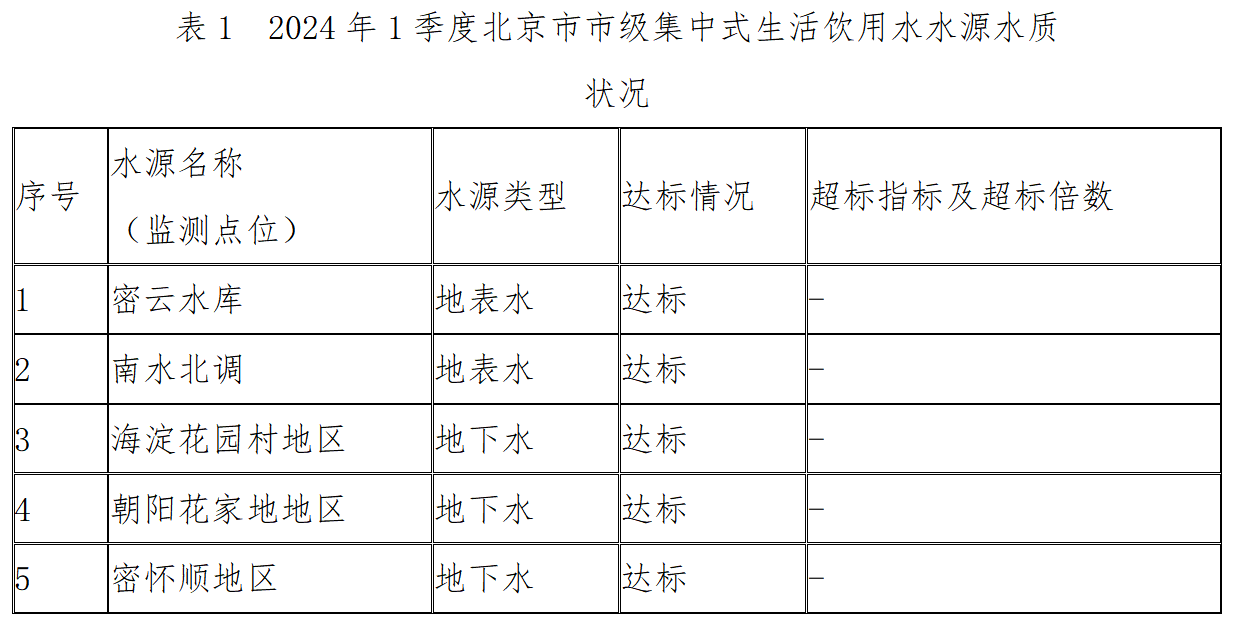
In the first quarter of 2024, the city monitored five municipal centralized drinking water sources, including two surface water sources (Miyun Reservoir and South-to-North Water Transfer Project) and three groundwater sources (Haidian garden village, Chaoyang Huajiadi and Mihuaishun).
2. Water from waterworks
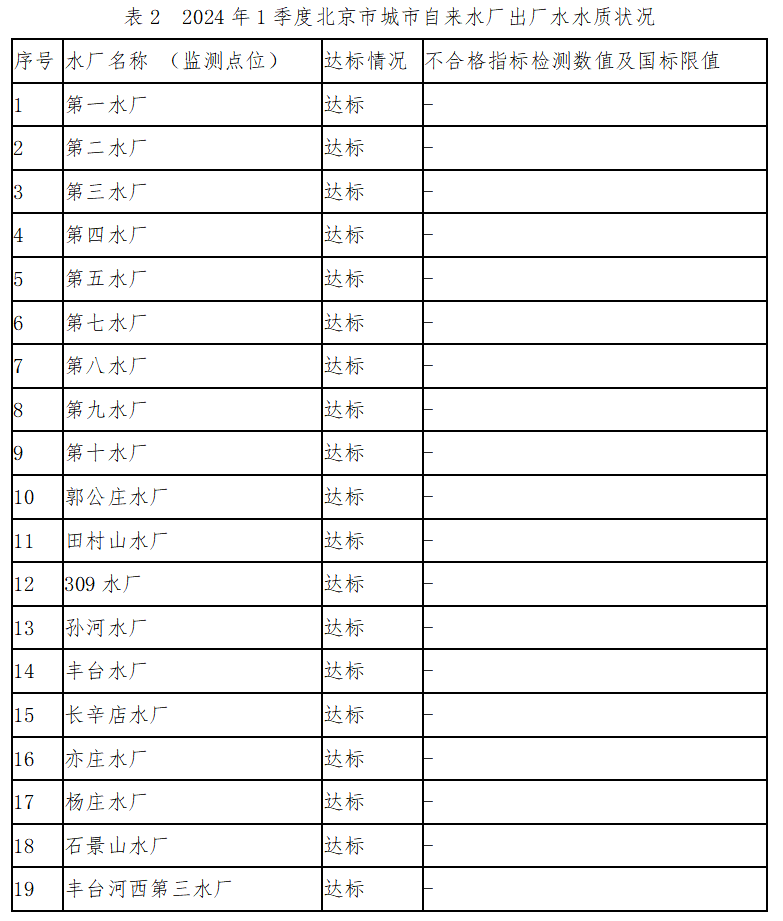
In the first quarter of 2024, the water quality of 19 urban waterworks was monitored.
3. Urban peripheral water
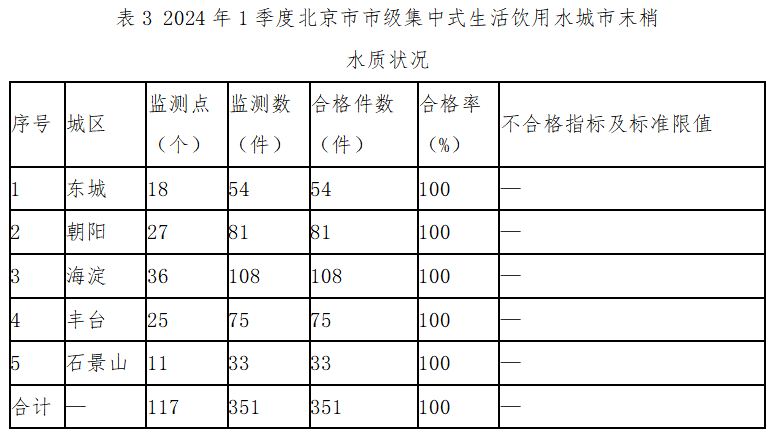
In the first quarter of 2024, 117 urban peripheral water monitoring points were set up for municipal centralized drinking water.
(2) Monitoring items
1. Drinking water sources
For surface water sources, the basic items in Table 1 (23 items except chemical oxygen demand), supplementary items in Table 2 (5 items) and optimized specific items in Table 3 (33 items) in the Environmental Quality Standard for Surface Water (GB 3838-2002) are tested every month, with a total of 61 indicators, and all 109 indicators are tested once a year.
Groundwater sources are tested for 39 conventional indicators in the Groundwater Quality Standard (GB/T 14848-2017) every month, and all 93 indicators are tested once a year.
2. Water from waterworks
The monitoring project is in accordance with the Hygienic Standard for Drinking Water (GB? 5749-2022), 43 routine indexes are tested for the factory water of each waterworks every month, all 97 indexes are tested for the factory water of surface waterworks every six months, and all 97 indexes are tested for the factory water of underground waterworks every year to ensure the safety of the factory water quality.
3. Urban peripheral water
The monitoring project is in accordance with the Hygienic Standard for Drinking Water (GB? 5749-2022), the routine indicators of urban peripheral water monitoring water samples were tested.
(3) Evaluation criteria and methods
1. Drinking water sources
According to Environmental Quality Standard for Surface Water (GB 3838-2002), the surface water source was evaluated by single factor evaluation method. When each index meets the requirements of the corresponding standards, the water quality is considered qualified.
According to the Groundwater Quality Standard (GB/T 14848-2017), the groundwater source is evaluated by single factor evaluation method. When each index meets the requirements of the corresponding standards, the water quality is considered qualified.
2. Water from waterworks
The factory water of waterworks is in accordance with Hygienic Standard for Drinking Water (GB? 5749-2022), using single factor evaluation method to evaluate. When each index meets the requirements of the corresponding standards, it is considered that the effluent quality of the water plant is qualified.
3. Urban peripheral water
Urban peripheral water according to the "sanitary standard for drinking water" (GB? 5749-2022) to evaluate the monitoring water samples, and give health tips for unqualified indicators according to the degree of harm to human health.
Second, the evaluation results
(A) the quality of drinking water sources
In the first quarter of 2024, the water quality of 2 surface water sources and 3 groundwater sources all reached the standard, with a compliance rate of 100.0%.
(2) Water quality of waterworks
In the first quarter of 2024, the water quality of 19 waterworks was all qualified, and the compliance rate was 100.0%.
(3) The quality of the terminal water
In the first quarter of 2024, 351 water samples were detected in 117 municipal centralized drinking water city peripheral water quality monitoring points, and the qualified rate was 100.0%.
See Table 1- Table 3 for the evaluation results.